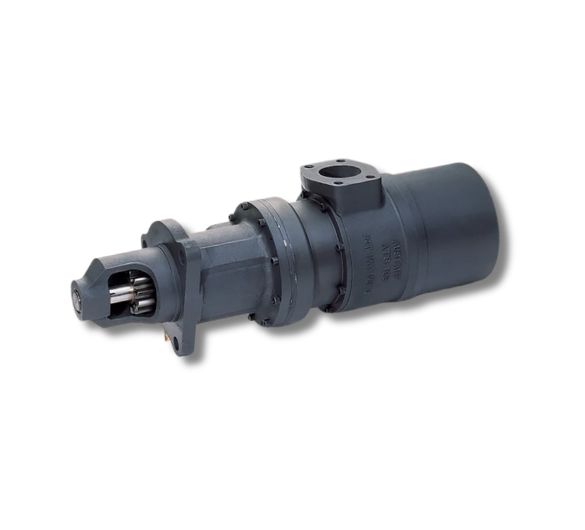
Austart ATS103 turbine air starter — heavy-duty compressed air pneumatic engine starting system with SAE 3 flange, pre-engaged piston drive, three-planet epicyclic gear reduction, and integrated muffler assembly for large diesel and gas engines
Turbine Air Starter
Turbine Driven | 150 psi Rated | SAE 3 Flange
Engine Starting Systems · Turbine Air Starters · Pneumatic Starters

Austart ATS103 Turbine Air Starter – Pre-Engaged Pneumatic Piston Drive for Heavy-Duty Diesel and Gas Engine Cranking

The Austart ATS103 turbine air starter is a heavy-duty compressed air-powered cranking system designed for consistent, reliable engine starting across the most demanding industrial environments. Rated to a maximum of 150 psi with a standard operating pressure of 100 psi, the ATS103 converts compressed air into high cranking torque through a precision turbine rotor and a three-planet epicyclic gear reduction, delivering that torque to the engine flywheel ring gear via an SAE 3 flanged nose assembly fitted with a pre-engaged pneumatic piston drive. Engineered as three independently serviceable sub-assemblies — nose, motor, and silencer — the ATS103 is purpose-built for spark-free starting duty in mining, oil and gas, marine, and stationary power generation applications where electrical starting systems are impractical or present unacceptable ignition risk.

Turbine Air Driven
150 psi Max Pressure
SAE 3 Flange Standard
16.24" Overall Length

The Austart ATS103 turbine air starter is a heavy-duty pneumatically driven cranking system that routes compressed air through a precision turbine rotor, then steps that high-speed rotation through a three-planet epicyclic gear reduction to deliver the sustained torque needed to crank large diesel and gas engines reliably across extreme operating environments. A pre-engaged pneumatic piston drive mechanism ensures the pinion is fully meshed with the engine flywheel ring gear before the turbine reaches cranking speed, providing a positive and controlled start cycle every time. Built as three independently serviceable sub-assemblies — nose, motor, and silencer — and entirely spark-free in operation, the ATS103 is engineered for applications where consistent starting performance and long service life matter as much as safety compliance.

  • Fully Spark-Free Compressed Air Operation for Hazardous Environments: The ATS103 operates entirely on compressed air, with no electrical components in the starting circuit — no batteries, no alternators, and no cabling that could arc or corrode. This inherently spark-free design makes the ATS103 the preferred choice for classified hazardous areas such as gas compression stations, petrochemical facilities, offshore platforms, and underground mining operations, where ignition risk from electrical starting equipment must be eliminated. Cranking performance remains consistent across the full supply pressure range from the standard 100 psi up to the 150 psi maximum, ensuring dependable engine starts even when the air receiver has not fully recharged between start cycles.
  • Pre-Engaged Pneumatic Piston Drive for Positive and Controlled Pinion Mesh: Rather than relying on centrifugal acceleration to seat the pinion, the ATS103 uses compressed air pressure acting on an internal piston assembly within the nose housing to push the pinion positively into engagement with the engine flywheel ring gear before the turbine rotor begins spinning. This guarantees that every tooth is fully meshed and load-bearing at the moment peak cranking torque is applied — eliminating the risk of partial engagement or gear clash under transient pressure fluctuations during the start event. For large, high-compression engines where reliable ring gear engagement is critical, the pre-engaged piston drive architecture provides the highest level of starting confidence.
  • SAE 3 Flange for Direct Mounting on a Wide Range of Heavy-Duty Engines: The ATS103 is built to the SAE 3 flywheel housing standard, with three equally spaced bolt holes of Ø 0.656 inch (16.7 mm) at 120-degree intervals, providing a direct and square mounting interface to the engine flywheel housing. This flange standard is common across a broad range of large heavy-duty diesel and gas engines in mining, marine, power generation, and process industry sectors. The ATS103 mounts without adaptor plates or custom spacers in most SAE 3 applications, ensuring correct pinion-to-ring-gear alignment from first installation through the entire service life of the starter.
  • Three-Planet Epicyclic Gear Reduction for High Cranking Torque at the Ring Gear: The nose assembly of the ATS103 incorporates a three-planet epicyclic (planetary) gear train that converts the high rotational speed produced by the turbine rotor into the lower speed and higher torque required to crank a large, high-compression engine. Three planet gears run on precision bearings within the spider hub assembly and are packed with lithium-based grease during assembly and maintenance servicing. This planetary reduction stage is the key mechanical link between turbine output and practical cranking performance — multiplying torque to the level required at the ring gear while maintaining a compact and well-balanced nose assembly.
  • 360° Indexable Housing for Flexible Air Port Routing: The connection between the ATS103 motor housing and nose assembly allows the housing to be repositioned to a different angular orientation relative to the nose without full disassembly. This enables the air supply inlet port to be directed to the most practical angle for hose and pipework routing in space-restricted engine compartments — whether the supply needs to approach from the top, side, or rear of the starter. This flexibility simplifies initial installation on congested engine packs and allows the unit to be reconfigured in the field if routing requirements change over the equipment's operational life.
  • Integrated Muffler Assembly for Controlled Exhaust Air Discharge: The ATS103 includes a purpose-built silencer assembly that meaningfully reduces the noise generated when high-pressure air exhausts from the starter at the end of each start cycle. The muffler uses an inner sleeve, foam insert, and outer sleeve arrangement retained by four through-studs and nuts, providing progressive acoustic attenuation of the exhaust airflow before it exits to atmosphere. Optional exhaust configurations including threaded outlet ports are available for enclosed machinery room installations or wherever exhaust air must be ducted away from the starter rather than discharged freely.
  • Three-Piece Modular Design for Straightforward Scheduled Maintenance: The ATS103 is structured as three distinct, independently serviceable sub-assemblies: the nose assembly housing the piston drive, planetary gear train, and pinion; the motor assembly containing the turbine rotor, rotor shaft, and bearings; and the silencer assembly. Each sub-assembly can be removed, inspected, and rebuilt separately using standard workshop tooling — including a hydraulic press and circlip pliers — without disturbing the rest of the unit. A genuine Austart service kit covering all seals, O-rings, piston rings, and bearings is available to support scheduled overhaul, returning the unit to full factory specification at each service interval.
  • Mining Equipment and On-Site Diesel Generating Sets: Surface and underground mining operations rely on large-displacement diesel engines to drive pumps, compressors, generators, and auxiliary plant — often in locations where electrical infrastructure is unreliable and conditions include high dust loading, vibration, and temperature extremes. The ATS103 operates entirely on the site compressed air network, delivering consistent starting performance without dependence on battery charge or electrical systems that degrade rapidly in abrasive and high-humidity underground environments. Its spark-free operation also satisfies the ignition-source control requirements of gassy mine workings where regulatory compliance for starting equipment is mandatory.
  • Marine Diesel Propulsion and Auxiliary Engine Starting: Commercial workboats, offshore support vessels, fishing vessels, and larger coastal craft powered by high-output diesel engines require a starting system that can perform consistently in salt-laden, high-humidity marine conditions over years of operational service. The ATS103 contains no electrical components in its starting circuit, eliminating the corrosion-related failure modes that affect conventional electric starter motors in the marine environment. Its robust turbine and planetary gear construction also handles the starting duty cycles typical of vessels that must restart engines quickly during operations at sea or in port.
  • Oil and Gas Engine-Driven Compressors and Wellhead Units: Gas engine-driven compressors and pump packages at wellheads, injection stations, and gas gathering facilities operate in Zone 1 and Zone 2 classified areas where ignition sources must be strictly controlled. The inherently spark-free pneumatic operation of the ATS103 makes it the standard choice for engine starting in these hazardous area environments, removing the complexity and certification cost of explosion-proof electrical starting systems entirely. Its capacity to deliver reliable starts under high-duty-cycle conditions makes it equally suited to continuous-run gas compression service where frequent engine starts are part of normal plant operations.
  • Stationary Diesel and Gas Generator Sets — Including Blackstart: Standby, prime power, and emergency generator sets driven by large diesel or gas engines must be able to crank a cold, high-compression engine on demand — including during a complete facility blackout when no external electrical supply is available. The ATS103 draws its starting energy from the stored compressed air in the receiver, providing a starting circuit that is fully independent of the generator electrical bus and capable of initiating blackstart and emergency generation sequences without any external power source. This independence from facility electrical infrastructure makes the ATS103 the preferred starting solution wherever generation reliability is a critical engineering requirement.
  • Industrial Engines in Process Plants, Refineries, and LNG Facilities: Process industry sites — refineries, petrochemical plants, gas processing units, and LNG terminals — use large diesel engines to drive emergency fire pumps, critical cooling machinery, and standby process equipment in locations where managing ignition risk is a primary safety engineering priority. The spark-free starting circuit of the ATS103, combined with optional threaded exhaust outlet configurations for enclosed machinery room installations, allows the unit to be specified into classified area installations without the additional regulatory burden associated with electrical ignition sources in these environments.
  • Remote Field Equipment, Drill Rigs, and Heavy Construction Plant: Large construction equipment, drill rigs, and remote field units powered by high-output diesel engines often operate at sites where battery-based starting is difficult to maintain because of temperature extremes, infrequent operator access, and high-vibration conditions that accelerate battery deterioration. The ATS103 delivers the same starting performance on the first attempt after an extended idle period as it does under continuous operational service — unaffected by ambient temperature, requiring no battery management, and drawing its starting energy directly from a locally charged air receiver that can be maintained by a small diesel-driven compressor at even the most remote sites.

Specifications listed below apply to the standard Austart ATS103 turbine air starter. Dimensional data is sourced from the official installation and maintenance documentation. Pinion and flange configurations are available in multiple options — contact us with your engine details for the correct part number.

Parameter Specification
Starter Type Turbine Air Starter (Pneumatic)
Drive Mechanism Pre-Engaged Pneumatic Piston Drive
Standard Operating Pressure 100 psi
Maximum Operating Pressure 150 psi
Control Port Size (Inlet & Outlet) 1/4" NPT
Minimum Supply Hose I.D. (up to 15 ft / 5 m) 1-1/2" (40 mm)
Minimum Supply Hose I.D. (over 15 ft / 5 m) 2" (50 mm)
Control Line Size Minimum 1/4" (6 mm) O.D.
Overall Length 16.242" (412.5 mm)
Flange to Pinion Distance 5.750" (146.1 mm)
Motor Housing Diameter Ø 3.623" (92.0 mm)
Flange Standard SAE 3
Mounting Hole Pattern 3 holes · Ø 0.656" (16.7 mm) · equally spaced at 120°
Pinion Rest Position Flange-to-Ring-Gear (FRG) spacing less 1/8" (3 mm)
Pinion Options (Right-Hand) 9TH 3MOD · 10TH 8/10 · 11TH 6/8 · 12TH 8/10
Pinion Options (Left-Hand) 9TH 3MOD · 10TH 8/10 · 11TH 6/8 · 12TH 8/10
Y Strainer (Required) 100 mesh · 1-1/2" BSP
Relay Valve (Required) RV1500 · 1-1/2" NPT (mounted directly upstream via Y strainer)
Turbine Rotor Nut Torque 25–30 ft lb (30–40 Nm)
Re-start Delay Minimum 15 seconds between start attempts
Special Options Available Threaded exhaust outlets · Alternate pinion tooth counts and modules · Left-hand pinion configurations · Mining-grade housing options
Warranty 12 months from date of purchase (first user)

How the Austart ATS103 Turbine Air Starter Works

When the operator activates the SC25 starter control button at the instrument panel or control station, a pneumatic control signal travels through the 1/4-inch control line to the RV1500 relay valve installed upstream of the starter. The relay valve opens, allowing high-pressure compressed air from the air receiver to flow through the 100-mesh Y strainer, which captures particulate contamination before it can reach the starter's precision internal components. Filtered supply air then enters the ATS103 turbine housing through the main inlet port and acts on the blades of the turbine rotor, spinning it rapidly under the force of the expanding compressed air.

Simultaneously, a portion of the supply air acts on the piston assembly within the nose housing, driving the piston forward along the bearing housing and pushing the drive assembly — and the pinion attached to it — outward into positive mesh with the engine flywheel ring gear. This pre-engagement occurs before the turbine reaches cranking speed, ensuring every tooth on the pinion is fully loaded and in contact with the ring gear by the time maximum cranking torque arrives. The turbine's high-speed rotational output passes through the rotor shaft into the nose assembly's three-planet epicyclic gear reduction, which steps the speed down and multiplies torque to the level required to turn over a large, high-compression diesel or gas engine.

Once the engine fires and accelerates beyond the cranking speed, the operator releases the control button. The relay valve closes, cutting the compressed air supply, and the turbine decelerates. The spring within the nose assembly retracts the piston and drive assembly, withdrawing the pinion cleanly from the ring gear as drive torque falls. Exhaust air from the turbine passes through the integrated silencer assembly — the foam insert and stacked sleeve arrangement progressively reducing discharge noise before air exits to atmosphere. A mandatory 15-second pause between consecutive start attempts ensures both the ATS103 and the engine have fully stopped rotating before re-engagement, protecting the drive components from impact damage.

Technical FAQ

Common Questions Answered

Can't find your answer? Contact our engineers →

The ATS103 is rated to a maximum supply pressure of 150 psi. The standard recommended operating pressure is 100 psi, which delivers optimal cranking torque while keeping all internal components within their design load limits. Operating at pressures approaching the 150 psi ceiling should be reserved for applications with a genuine high-compression starting requirement and must not become the routine operating condition. The air receiver supplying the ATS103 must be manufactured to an applicable pressure vessel code such as AS1210 or an equivalent recognised standard.

The ATS103 uses a pre-engaged pneumatic piston drive. When the start cycle is initiated, compressed air simultaneously powers the turbine and acts on an internal piston that pushes the pinion into positive mesh with the engine ring gear before the turbine reaches cranking speed. This contrasts with an inertia drive, where the pinion is extended by centrifugal force as the output shaft accelerates — a mechanism that relies on sufficient rotational speed to achieve engagement. The pre-engaged drive ensures full tooth contact at the moment of peak cranking torque, providing a more controlled and consistent start cycle, particularly on large engines and in applications where reliable engagement on every attempt is critical.

The ATS103 is built to the SAE 3 flywheel housing standard, with three equally spaced bolt holes of Ø 0.656 inch (16.7 mm) at 120-degree spacing. SAE 3 is a widely used flange standard across large heavy-duty diesel and gas engines in mining, marine propulsion, oil and gas compression, and stationary power generation. Multiple pinion configurations in both right-hand and left-hand variants — covering 9-tooth, 10-tooth, 11-tooth, and 12-tooth options across standard pitch and module specifications — are available to match different ring gear designs. Please provide your engine make, model, and ring gear specification so the correct full part number can be confirmed for your application.

The ATS103 installation requires a 100-mesh Y strainer fitted upstream in the main supply line, with the RV1500 relay valve (1-1/2 inch NPT) connected directly to the strainer outlet via a short nipple. The Y strainer protects both the relay valve seat and the starter's precision turbine and drive components from particulate contamination that can accumulate in the air receiver over time. A minimum 1/4-inch (6 mm) O.D. control line connects the SC25 starter control button to both the relay valve and the starter control inlet port. Fitting the Y strainer is a mandatory requirement of the product warranty and must not be omitted from the installation.

A minimum interval of 15 seconds is required between consecutive start attempts. This pause allows the ATS103 turbine rotor, output drive assembly, and the engine itself to come to a complete standstill before the control is re-activated. Attempting to initiate a new start cycle while any of these components are still rotating can cause significant impact damage to the pinion teeth, flywheel ring gear, and the internal piston and drive mechanism — damage that is excluded from warranty coverage. Always confirm visually that all rotating components have fully stopped before initiating the next start attempt.

Yes. The connection between the ATS103 motor housing and nose assembly allows the housing to be repositioned to a different angular orientation without complete disassembly of the unit. This makes it practical to redirect the air supply inlet and control ports to the most convenient angle for hose or pipework routing — a significant advantage in engine compartments where access is restricted from certain directions or where the starter must be installed in a non-standard orientation. Always follow the installation manual's procedure and torque specifications when repositioning the housing to ensure a sealed and correctly loaded joint.

Free Technical Consultation

Get Your Datasheet
+ Quote in 24 Hours

Our engineers will confirm the correct ATS103 flange code, pinion configuration, and system components — including relay valve, Y strainer sizing, and air supply line requirements — and provide full technical documentation and a competitive quote tailored to your engine and application.

  • Response guaranteed within 24 hours
  • Full technical datasheet included
  • Flange, pinion & system component selection guidance
  • OEM & bulk pricing available

Quick Quote Request

No spam ever · Response within 24 hours

Our Product Partners
Enovation Controls FW Murphy Production Controls Austart Air Starters MCS Mobile Control Systems AXI International Pacbrake Engine Exhaust Senquip Telemetry Enovation Controls FW Murphy Production Controls Austart Air Starters MCS Mobile Control Systems AXI International Pacbrake Engine Exhaust Senquip Telemetry