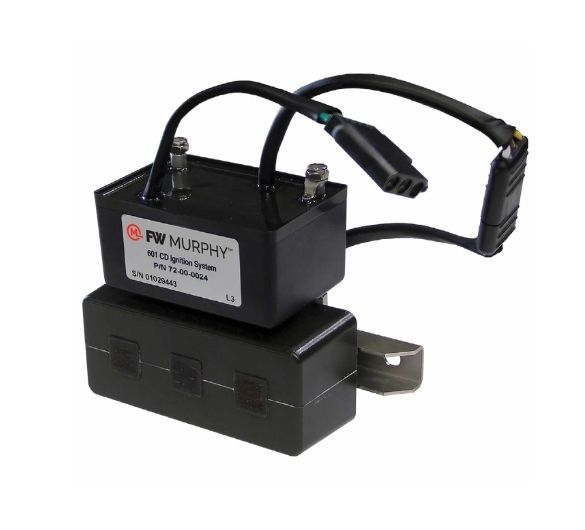
The 601 CD Ignition System is a self-powered capacitor discharge ignition control engineered for large flywheel, spark-ignited single-cylinder engines. Mounted directly in proximity to the flywheel, its electromagnetic charging circuitry generates all the energy required to deliver a 30,000-volt spark — even at low cranking speeds — without relying on any external battery or power supply. Crankshaft-referenced dual trigger timing and a fully sealed electronics module make this a durable, low-maintenance ignition solution for demanding field environments.
The 601 CD Ignition System is a proven, field-ready capacitor discharge ignition solution for large flywheel spark-ignited engines operating in oil and gas production, power generation, and remote industrial environments. By harnessing energy directly from the rotating flywheel through a dedicated charging bar and electromagnetic coil assembly, the unit eliminates the need for external batteries, alternators, or power wiring — significantly simplifying installation on engine-mounted control panels. The sealed electronic module protects ignition circuitry from moisture, vibration, and contamination, while crankshaft-referenced dual trigger timing delivers accurate and repeatable spark advance across the full engine speed range, from initial cranking through normal operating load.
The 601 CD Ignition System is available as a complete single-cylinder ignition kit. All key dimensional and functional parameters are listed below for engineering reference and procurement use.
| Parameter | Specification |
|---|---|
| Ignition Type | Capacitor Discharge (CD) |
| Output Voltage | 30,000 V at low RPM |
| Power Source | Self-Powered (Electromagnetic / Flywheel Charging) |
| Timing Reference | Crankshaft-Referenced (Flywheel Mounted) |
| Trigger Configuration | Dual Trigger |
| Engine Application | Single-Cylinder, Large Flywheel, Spark-Ignited |
| Control Module | Fully Sealed (Potted) Electronic Module |
| External Power Required | None |
| Panel Power Output | Provides power for ignition-powered control panels |
| Moving Parts (Module) | None |
| Module Body Dimensions | 3.25 in. W × 2.25 in. H × 0.875 in. D (83 × 57 × 22 mm) |
| Overall Assembly Dimensions | 5.5 in. × 4.5 in. × 4.0 in. (140 × 114 × 102 mm) |
| Charging Bar Diameter | 0.266 in. (7 mm) |
| Charging Bar Thickness | 0.50 in. (13 mm) |
| Charging Bar Height | 1 in. (25 mm) |
| Shipping Weight (Complete Kit) | 3 lb. 5 oz. |
| Shipping Dimensions (Complete Kit) | 6½ × 4½ × 8¾ in. |
| Warranty | Two Years |
The 601 operates on a flywheel-integrated energy harvesting principle. A trigger magnet bar is bolted to the engine flywheel with its run magnet positioned at the crankshaft timing angle selected for normal engine operation. As the flywheel rotates, the charging bar — mounted in fixed proximity to the flywheel — passes through the magnetic field of the generator coil assembly, inducing an alternating current that charges an internal capacitor within the sealed electronic module.
At the precise moment the trigger magnet bar passes the trigger coil, the coil generates a signal that fires the ignition module. The module discharges the stored capacitor energy through the ignition coil, producing a high-voltage 30,000-volt spark at the engine's spark plug. Because timing is taken directly from the flywheel position, the spark advance angle remains accurately referenced to actual piston position throughout the full speed range — from initial cranking through full-load operation.
The ignition unit itself is installed on mounting brackets positioned approximately 30 degrees more advanced than the trigger magnet bar location on the flywheel. This installation geometry establishes the correct base timing reference for the trigger coil and module pair. With no mechanical contacts to adjust, no distributor to wear, and no external power connections to maintain, the 601 continues delivering consistent ignition performance with minimal intervention across its service life.
The 601 CD Ignition System is designed for large flywheel, spark-ignited single-cylinder engines. It is broadly compatible with most engines that use a standard large flywheel arrangement and require capacitor discharge ignition, including natural gas engines, propane engines, and gasoline-fuelled stationary engines commonly found across oil and gas production, irrigation, and power generation applications.
No. The 601 is entirely self-powered through its flywheel-driven electromagnetic charging system. The charging bar and generator coil assembly harvest energy directly from the rotating flywheel during each revolution, storing it in the capacitor within the sealed module — eliminating the need for any external battery, alternator, or power wiring to the ignition system.
The 601 produces 30,000 volts at low RPM, which is significantly higher than the output of many conventional ignition systems. This high-voltage output is important because it ensures a strong, consistent spark across a wide range of conditions — including lean fuel mixtures, worn spark plugs, cold ambient temperatures, and low cranking speeds — all of which can prevent weaker ignition systems from firing reliably.
Yes. The 601's generator coil produces surplus electrical energy beyond what the ignition system itself consumes, and this excess power can be used to operate ignition-powered engine control panels. This enables panel-mounted instruments, alarms, and protective shutdown devices to run directly from the ignition system without a dedicated control panel power supply — a significant advantage for remote and unmanned engine installations.
Timing is established by positioning the trigger magnet bar on the flywheel at the desired crankshaft advance angle for normal running, and then mounting the ignition module on brackets approximately 30 degrees further advanced from that position. The trigger coil, installed in fixed proximity to the flywheel, senses the passing trigger magnet and signals the module to fire. Detailed installation instructions covering timing setup are provided with every complete kit.
The 601 is designed for minimal maintenance. The sealed electronic module contains no moving parts or adjustable contacts and requires no internal servicing. Routine field checks are limited to verifying wiring connections, inspecting the trigger and charging bar air gaps, and checking the ignition coil and spark plug condition at standard engine service intervals. There are no breaker points, distributor caps, or timing adjustment mechanisms to service.
Our engineers will confirm 601 CD Ignition System compatibility with your engine, provide the full technical datasheet and wiring diagram, and deliver a competitive quote for your specific application.
.png)
.png)
.png)
.png)
.png)
.png)
.png)
.png)