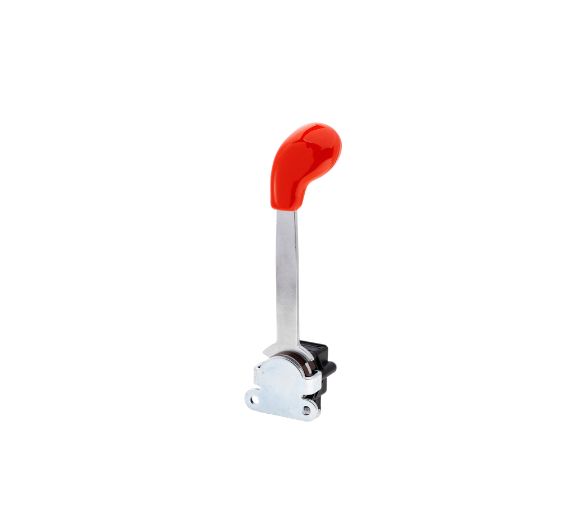
The 976 000 Series is a ruggedised electronic hand throttle engineered for precise engine speed management in off-highway vehicles, marine vessels, and industrial machinery. With a 45° travel angle, IP69K-rated sealing against dust and high-pressure washdown, and factory-programmable output signals including CAN J1939 and CANopen, this throttle controller delivers the reliability and versatility demanded by modern electronically controlled engines across the most challenging operating environments.
The 976 000 Series electronic hand throttle is a purpose-built engine speed control device designed for applications where reliability, sealing integrity, and signal flexibility are non-negotiable. Utilising a non-contact sensor technology within a compact lever assembly, it provides smooth and repeatable throttle actuation across a 45° arc. The output signals are factory configurable to match a wide range of ECU interfaces, supporting analogue voltage, PWM, current loop, IVS, CAN J1939, and CANopen protocols. Compliant with key automotive and electrical standards including FMVSS 124 and ISO 26262 ASIL C, this throttle lever is a dependable choice for construction equipment, agricultural machinery, marine engines, and any application where harsh conditions demand uncompromising build quality.
The 976 000 Series combines sealed mechanical construction with flexible electronic output capability, making it a highly adaptable throttle solution for demanding commercial and industrial environments.
Performance and configuration data for the 976 000 Series electronic hand throttle. Output signal values are factory programmable; confirm requirements at time of order.
| Parameter | Specification |
|---|---|
| Product Series | 976 000 Series |
| Travel Angle | 45° |
| Ingress Protection Rating | IP69K (Water and Dust) |
| Operating Temperature | -40°C to +85°C |
| Storage Temperature | -40°C to +125°C |
| Connector Type | AMP – 6 pins |
| Output Signal Options | Analogue, PWM, IVS, Current, CAN J1939, CANopen (factory programmable) |
| Output Configuration | Factory programmable to customer specification |
| Functional Safety | ISO 26262 Part 5 – ASIL C (SEooC) * |
| EMC Standard | ECE R10.06 * |
| Throttle Return Safety Standard | FMVSS 124 |
| Flammability Standard | FMVSS 302 / ECE R118 |
| EMC Directive | 72/245/EEC |
| Type Approval | E13 Report |
| Lever Options | Multiple standard profiles available; custom levers on request |
| Knob Options | Multiple standard knobs available |
| Connectivity Options | Standard connector kit or custom wire harness |
| * ISO 26262 ASIL C and ECE R10.06 apply to APS Dual 5V and APS CAN sensor configurations only. | |
The 976 000 Series electronic hand throttle replaces the traditional mechanical cable linkage with a compact, electronically sensing lever assembly. When the operator moves the throttle lever, a non-contact angular position sensor — mounted within the sealed housing — detects the lever's precise position across the 45° travel range. This positional data is converted into an electronic output signal, which is then transmitted via the AMP 6-pin connector to the engine control unit (ECU) or throttle controller.
The specific output signal format — whether analogue voltage, PWM, current loop, IVS, CAN J1939, or CANopen — is configured at the factory prior to delivery, ensuring direct compatibility with the target ECU without the need for additional signal conditioning. The ECU interprets the signal and adjusts fuel delivery accordingly to achieve the commanded engine speed. Because the sensing element operates without physical contact, there are no wear-prone wipers or resistive tracks, resulting in a consistent, repeatable throttle response throughout the product's service life. For safety-critical applications, the optional dual-channel APS sensor configuration provides the redundant signal path required to achieve ISO 26262 ASIL C functional safety classification, enabling the host system to detect sensor faults and take appropriate action before a hazardous condition can develop.
An electronic hand throttle uses a position sensor inside the lever to generate an electronic signal that is sent directly to an engine control unit (ECU). Unlike a mechanical throttle, which uses a physical cable to open a fuel rack or throttle plate, an electronic hand throttle has no mechanical linkage between the lever and the engine. This eliminates cable routing challenges, reduces wear, and allows the output to be tailored to any ECU protocol — including CAN J1939, PWM, or analogue voltage — without hardware changes.
IP69K is the highest ingress protection rating under the IEC 60529 standard. It confirms that the throttle is completely sealed against dust and can withstand a sustained high-pressure, high-temperature water jet (80 bar, 80°C) applied at close range from all directions. This makes the 976 000 Series suitable for machinery that requires regular pressure washing, such as agricultural equipment, food-grade vehicles, construction plant, and marine applications where water exposure is unavoidable.
The throttle supports Analogue (voltage), PWM (pulse-width modulation), IVS (idle validation switch), Current (loop), CAN J1939, and CANopen output formats. The specific output type and its voltage or data range values are configured at the factory before shipment, meaning the unit arrives ready to connect directly to the customer's ECU without any further calibration or signal conversion.
Yes. When equipped with APS Dual 5V or APS CAN sensor configurations, the 976 000 Series achieves certification to ISO 26262 Part 5 at ASIL C level, classified as a Safety Element out of Context (SEooC). This is a rigorous automotive functional safety standard that demonstrates the throttle's sensor and signal chain are designed to detect internal faults, enabling the host system to implement safe-state reactions. It is particularly relevant for off-highway and industrial applications with defined safety integrity requirements.
Yes. Multiple standard lever profiles and knob styles are available to suit different operator preferences and ergonomic requirements. For OEM programmes with specific spatial or aesthetic constraints, fully custom lever geometries can be produced. Connector kits and custom wire harnesses are also available to streamline integration into existing vehicle wiring systems and reduce on-line assembly time.
The 976 000 Series complies with FMVSS 124 (throttle return to idle safety), FMVSS 302 / ECE R118 (flammability), 72/245/EEC and ECE R10.06 (electromagnetic compatibility), and holds an E13 type approval report. These standards cover North American federal vehicle safety requirements as well as European homologation requirements, enabling the product to be specified into vehicles sold in multiple markets without requiring separate regulatory assessment.
Our engineers will confirm the correct 976 000 Series configuration for your application — including output signal type, lever option, connector specification, and any functional safety documentation requirements. Whether you need a standard off-the-shelf unit or an OEM-specific custom build, we provide full technical documentation and a competitive, project-specific quote.
.png)
.png)
.png)
.png)
.png)
.png)
.png)