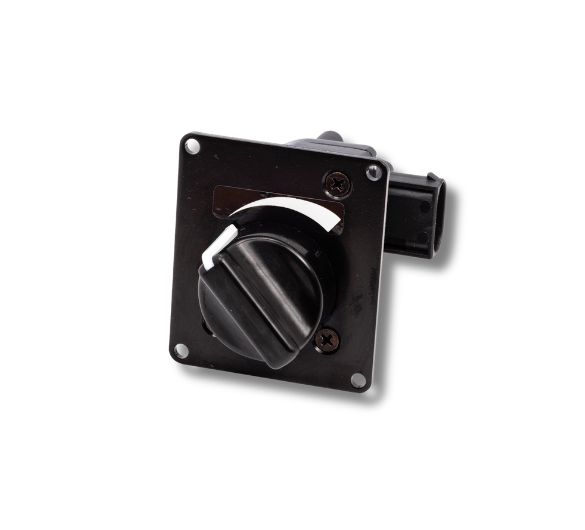
The 973 000 series is a durable, industrial-grade electronic rotary control engineered for precise position sensing in challenging environments. With a defined 90° travel angle, IP69K ingress protection, and a wide -40°C to +85°C operating range, this sensor delivers reliable performance for off-highway vehicles, agricultural machinery, and material handling equipment.
The 973 000 series electronic rotary control is a programmable position sensor designed to translate rotational input into a precise electronic signal for engine and equipment management. As a core component in drive-by-wire systems, it replaces mechanical linkages, enhancing reliability and reducing maintenance. Common applications include electronic throttle controls, operator joysticks, steering input sensing, and adjustable armrest positioning. Its robust, sealed design ensures consistent operation in high-vibration, dusty, and high-moisture environments, from mining sites to marine vessels, where IP69K protection guarantees resistance to high-pressure, high-temperature washdowns. This series provides engineers with a versatile, safety-compliant solution for critical control functions.
The 973 000 series is engineered to provide precise, reliable position feedback in demanding applications, offering a unique combination of mechanical robustness, environmental sealing, and electronic configurability.
Key technical parameters for the 973 000 series electronic rotary control. Options may alter values based on configuration.
| Parameter | Specification |
|---|---|
| Model | 973 000 series |
| Travel Angle | 90° |
| Ingress Protection | Up to IP69K (water and dust ingress) |
| Operating Temperature | -40°C to +85°C |
| Storage Temperature | -40°C to +125°C |
| Electrical Connector | AMP – 6 pins |
| Output Signal Options | Analogue; PWM; IVS; Current; CAN J1939; CANopen |
| Safety & Compliance | FMVSS 124; FMVSS 302; 72/245/EEC; ECE R10.06; E13 report; ISO 26262 ASIL C (selected variants) |
The 973 000 series electronic rotary control operates on a non-contact Hall-effect sensing principle. As the operator rotates the control shaft through its 90° range, a magnet integrated into the rotor moves relative to a stationary Hall-effect sensor integrated circuit. This movement generates a proportional voltage change, which is then conditioned and converted by the internal electronics into the chosen output signal format (e.g., analogue 0.5-4.5V, PWM, or CAN J1939 message).
The sensor requires a regulated DC supply voltage and provides a signal that correlates directly to the shaft angle. This output is then read by a vehicle's Engine Control Unit (ECU), a Programmable Logic Controller (PLC), or other automation controllers. The robust, sealed housing ensures the internal electronics remain protected from moisture and debris, while the contactless sensing technology guarantees a long operational life with no mechanical wear, ensuring repeatable accuracy for thousands of cycles.
The 973 000 series features a fixed 90° travel angle, while the 978 000 series offers a choice of 90° or 160° travel, making it suitable for applications requiring a wider rotational range. Both series share IP69K protection and similar output signal options.
ASIL C (Automotive Safety Integrity Level C) is a risk classification defined by the ISO 26262 standard. For the 973 000 series, this rating indicates the sensor has been developed as a Safety Element out of Context (SEooC) for use in safety-critical systems, offering high reliability and rigorous diagnostic coverage.
The output configuration (type, curve, range) is factory-programmed to customer specifications before delivery. As an end user, you cannot reprogram the output in the field. However, the device can be ordered with any of the supported protocols (Analogue, CAN J1939, etc.) to match your specific system requirements.
IP69K is specifically required for applications subject to high-pressure, high-temperature washdowns, such as in food processing, marine, or heavy-duty construction equipment cleaning. For standard outdoor use exposed only to rain and dust, lower IP ratings might suffice, but IP69K provides the highest level of protection for harsh conditions.
The IVS is a discrete, independent switch output that signals when the control is in the idle or zero position. This provides a redundant safety check for electronic throttle systems, confirming to the ECU that the operator has released the input device, which is required for FMVSS 124 compliance.
Our engineers will confirm the correct 973 000 series configuration for your specific voltage, output signal, and environmental requirements. Whether you need a standard analogue unit or a safety-rated CAN J1939 variant, we provide full technical documentation and a competitive quote tailored to your equipment.
.png)
.png)
.png)
.png)
.png)
.png)
.png)