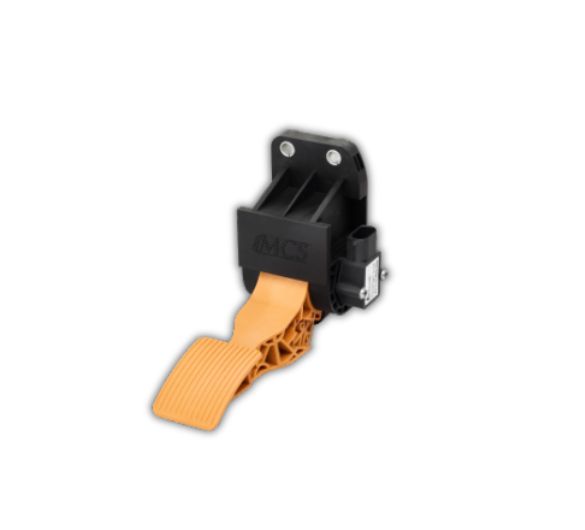
The MCS 963 000 series electronic suspended throttle pedal is a high-performance, industrial-grade accelerator pedal engineered for precision drive-by-wire control in harsh environments. Designed for off-highway vehicles, heavy trucks, and mobile equipment, this rugged suspended foot pedal replaces mechanical linkages with programmable electronic outputs, including analogue, PWM, and CAN J1939 protocols. With IP69K ingress protection, dual redundant return springs, and ISO 26262 ASIL C compliance, the 963 000 series delivers reliable, fail-safe throttle control in extreme temperatures and high-vibration applications.
The MCS 963 000 series electronic suspended throttle pedal sets a new standard for durability and precision in electronic throttle control. Constructed with a robust PA66+GF30 injection-molded housing, this drive-by-wire foot pedal is designed to survive the toughest industrial environments—from dust-laden agricultural fields to high-moisture marine engine rooms. Its factory-programmable outputs allow seamless integration with modern ECUs, while dual redundant return springs provide critical fail-safe mechanical return. Whether you need analogue, PWM, or CAN J1939 communication, the 963 000 series delivers consistent, linear throttle response that operators trust.
Specifications listed below apply to the standard MCS 963 000 series electronic suspended throttle pedal. Dual sensor and CAN J1939 variants available — contact us for configuration options.
| Parameter | Specification |
|---|---|
| Series / Model | Electronic Suspended Throttle Pedal 963 000 series |
| Rest Position / Travel Angle | 15° / 24° |
| Return Mechanism | Dual "built-in" return springs |
| Housing Material | Polyamide PA66 + 30% Glass Fiber (Injection Molding) |
| Ingress Protection (IP) Rating | Up to IP69K (water and dust ingress) |
| Operating Temperature | -40°C to +85°C |
| Storage Temperature | -40°C to +125°C |
| Electrical Connector | AMP 6-pins (waterproof, IP69 rated) |
| Output Signal Options (Programmable) | Analogue, PWM, IVS, Current, CAN J1939, CANopen |
| Sensor Configuration Options | Single sensor, dual sensors (up to 4 output signals) |
| Safety Integrity Level | ISO 26262 Part 5 – ASIL C (SEooC) for APS Dual 5V / APS CAN versions |
| Compliance & Standards | FMVSS 124, FMVSS 302 (ECE R118), 72/245/EEC, ECE R10.06, E13 report |
| Optional Features | Mechanical kick-down, swivel arm, CAN J1939 connector kit, custom wire harness |
The MCS 963 000 series operates on the drive-by-wire principle, converting mechanical foot pressure into a precise electronic signal for the engine's Electronic Control Unit (ECU). When the operator depresses the suspended pedal, it pivots through a 24° arc. A non-contact position sensor—either potentiometric or Hall-effect depending on configuration—detects this angular displacement and generates a proportional voltage, PWM, or digital CAN signal.
This signal is transmitted via the sealed AMP 6-pin connector directly to the vehicle's ECU. The ECU interprets the signal variation (for example, 0.5V at idle position to 4.5V at full throttle) and commands the engine's fuel injection system or electronic throttle body to adjust engine speed accordingly. The dual built-in return springs provide mechanical hysteresis and ensure the pedal physically returns to the 15° rest position when released—a critical safety feature. For CAN J1939 variants, the pedal operates as a smart network node broadcasting pedal position data digitally for advanced vehicle integration and diagnostics.
A suspended pedal hangs from a bracket under the dashboard, freeing up floor space for the operator's feet. In contrast, a floor-mounted pedal sits on the cab floor. The suspended design of the 963 000 series is preferred in commercial vehicles and off-highway machinery because it is less susceptible to debris accumulation around the pedal mechanism and allows for easier cab cleaning.
Yes. The 963 000 series offers digital output options including standard CAN J1939 and CANopen protocols. This allows the throttle pedal to communicate directly with the vehicle's ECU and network, reducing wiring harness complexity while providing advanced diagnostic capabilities and real-time pedal position data.
IP69K is the highest ingress protection rating against high-pressure, high-temperature water jets. This means the pedal is fully dust-tight (IP6X) and can withstand direct spray from industrial pressure washers used to clean heavy machinery. It is ideal for agriculture, mining, and food-processing vehicles where rigorous daily cleaning is required.
The dual redundant return springs provide a mechanical failsafe. If one spring breaks or fatigues over time, the second spring maintains sufficient force to return the pedal to the idle position. This redundancy prevents the pedal from sticking in an open-throttle condition and ensures operator safety.
The pedal outputs are factory-configurable to match your specific engine ECU. Options include analogue (0-5V), Pulse Width Modulation (PWM), Idle Validation Switch (IVS), current loop, CAN J1939, and CANopen. This flexibility allows seamless integration with virtually any modern engine management system.
ASIL C (Automotive Safety Integrity Level C) certification per ISO 26262 Part 5 indicates that the pedal is designed to manage specific risks related to unintended acceleration or signal loss. When configured with APS Dual 5V or APS CAN sensors, the pedal meets strict safety integrity requirements, reducing system failure risk and meeting OEM safety standards.
Our engineers will confirm the correct pedal configuration (output signal, sensor redundancy, connector options) for your application — and provide full technical documentation and a competitive quote tailored to your vehicle type, environmental requirements, and integration needs.
.png)
.png)
.png)
.png)
.png)
.png)
.png)