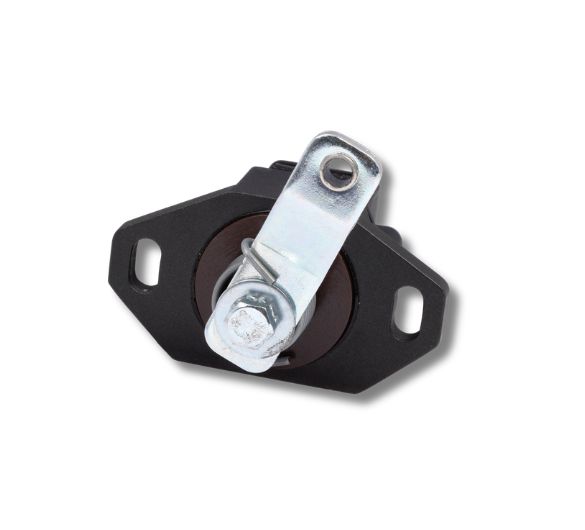
The 974 000 series electronic throttle position sensor is a heavy‑duty solution for precise throttle plate position measurement in industrial engines and mobile machinery. Housed in a robust die‑cast aluminum enclosure with IP69K ingress protection, it withstands extreme temperatures, water jets and dust exposure. Factory‑programmable output signals — including CAN J1939, PWM and analogue — enable seamless integration with modern engine control units (ECUs) and electronic throttle control systems.
The 974 000 series electronic throttle position sensor is designed for accurate angular position measurement of throttle valves in industrial engines and off‑highway equipment. It converts the rotational movement of the throttle shaft into an electrical signal that the engine control unit uses to regulate fuel delivery, air‑fuel ratio and engine speed. Built around a rugged die‑cast aluminum housing, the sensor operates reliably in temperatures from -40°C to +85°C and survives high‑pressure washdowns thanks to its IP69K sealing. Whether used in construction machinery, agricultural tractors or marine propulsion systems, the 974 000 series delivers precise throttle feedback, improving fuel efficiency and reducing emissions in electronic throttle control systems.
The 974 000 series electronic throttle position sensor combines rugged construction with versatile electronics, delivering accurate throttle feedback in the most demanding industrial environments.
Key performance and dimensional data for the 974 000 series electronic throttle position sensor. Specifications are based on standard configuration; options may alter values.
| Parameter | Specification |
|---|---|
| Series | 974 000 |
| Travel Angle | 42° (idle to full throttle) |
| Return Mechanism | One return spring |
| Housing Material | Die‑cast aluminum |
| Ingress Protection | IP69K (dust‑tight, high‑pressure water jets) |
| Operating Temperature | -40°C to +85°C |
| Storage Temperature | -40°C to +125°C |
| Connector Type | AMP‑6 pins (waterproof) |
| Output Signals (Factory Programmable) | Analogue, PWM, IVS, Current (4‑20 mA), CAN J1939, CANopen |
| Functional Safety (selected models) | ISO 26262 Part 5 – ASIL C (SEooC) |
| Regulatory Compliance | FMVSS 124, FMVSS 302 (ECE R118), 72/245/EEC, ECE R10.06, E13 report |
| Mounting Orientation | Two rotation senses (clockwise / counter‑clockwise) |
The 974 000 series electronic throttle position sensor mounts directly onto the throttle body spindle or shaft of an internal combustion engine. As the throttle valve rotates — either by a mechanical cable, electronic throttle pedal, or control lever — the sensor’s internal potentiometer or Hall‑effect element converts the angular displacement into a proportional electrical signal. This signal is transmitted to the engine control unit (ECU) via one of several factory‑programmed output formats, such as analogue voltage, PWM or CAN J1939. The ECU reads the throttle position data and adjusts fuel injection quantity, injection timing and ignition timing accordingly to achieve the desired engine speed and power output. A single internal return spring ensures the throttle mechanism reliably returns to the idle position when the operator releases the throttle. The sensor’s IP69K‑rated housing protects internal electronics from dust, moisture and high‑pressure washdowns, ensuring long‑term signal accuracy even in extreme environments.
An electronic throttle position sensor monitors the position of the throttle valve in an engine. It converts the valve's angular position into an electrical signal that the engine control unit uses to adjust fuel injection, air‑fuel mixture and ignition timing.
The 974 000 series features an IP69K ingress protection rating. This means it is completely dust‑tight and can withstand high‑pressure, high‑temperature water jets and steam cleaning, making it suitable for use in harsh industrial environments.
The sensor is factory‑programmable and supports multiple output formats: analogue (voltage), Pulse Width Modulation (PWM), current (4‑20 mA), Idle Validation Switch (IVS), CAN J1939 and CANopen. This ensures compatibility with a wide range of engine control systems.
Yes, the APS Dual 5V and APS CAN variants of the 974 000 series are developed as a Safety Element out of Context (SEooC) in accordance with ISO 26262 Part 5 and meet ASIL C requirements. This makes them suitable for safety‑critical automotive and industrial control applications.
The sensor operates reliably in temperatures ranging from -40°C to +85°C, with a storage temperature range of -40°C to +125°C. This wide range ensures dependable performance in both freezing climates and high‑heat environments.
Typical applications include construction machinery, agricultural tractors, mining equipment, marine diesel engines, emergency generator sets, and material handling vehicles. It is also used in drive‑by‑wire throttle systems and joystick control integrations.
Our engineers will confirm the correct 974 000 series configuration for your specific application requirements. Whether you need analogue output, CAN J1939, or ASIL C certified variants, we provide full technical documentation and a competitive quote tailored to your operating environment.
.png)
.png)
.png)
.png)
.png)
.png)
.png)