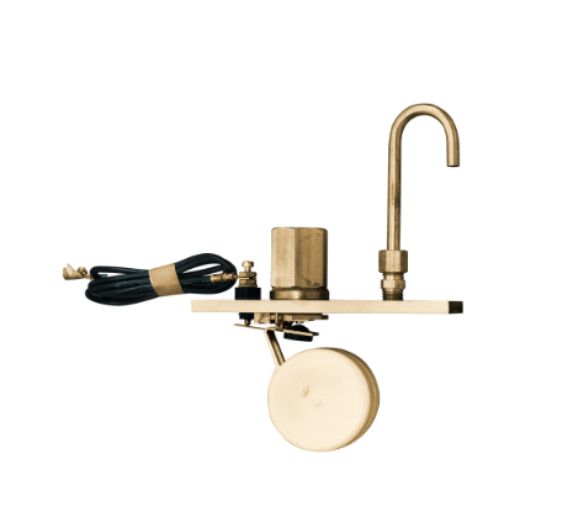
The LR500 Series oil level regulator is a float-controlled device that automatically replenishes oil in a lubricator from a gravity-fed supply reservoir, maintaining the factory-recommended operating level at all times. Each model is equipped with a built-in low-level shutdown switch that activates an alarm or halts equipment operation if the oil supply is depleted — providing continuous lubrication protection without the need for manual checks or periodic refills.
The LR500 Series is a range of automatic oil level regulators designed to keep lubricator oil at the precise level required for correct machine operation. Supplied by a gravity-fed oil reservoir mounted above the unit, the regulator uses a float mechanism to control oil flow into the lubricator — eliminating the manual effort associated with routine oil checks and top-ups. Suitable for use with Lincoln lubricators, the series includes three model variants — LR579, LR589, and LR589NC — each providing automatic oil level control combined with a low-level protective switch that safeguards connected equipment against oil starvation. The result is improved uptime, reduced maintenance overhead, and consistent lubrication performance across demanding industrial applications.
The LR500 Series is available in three model variants — LR579, LR589, and LR589NC — all designed for Lincoln lubricator installations. Key specifications for engineering reference and procurement use are listed below.
| Parameter | Specification |
|---|---|
| Available Models | LR579, LR589, LR589NC |
| Compatible Lubricator | Lincoln Lubricators |
| Oil Inlet Connection | ½ NPT |
| Switch Rating | 2 A @ 20 V AC/DC, resistive |
| LR579 Shut-Down Contact | Adjustable (field-settable trip point) |
| LR589 / LR589NC Switch Type | Mercury bulb in hermetically-sealed mercury switch |
| LR589NC Wiring Configuration | Normally Closed (NC) |
| Float Material (LR579) | 304 Stainless Steel |
| Case Material (LR579) | Aluminum |
| Thumb-Valve Seal (LR579) | Viton (pressure-seal type) |
| Vent Tube (LR579) | ¼ in. (6 mm) Copper |
| Wire (LR579) | 18 AWG x 24 in. (1.0 mm² x 610 mm) with Ring Terminal |
| Hex Size (LR579) | 1 inch |
| Weight — LR579 | 12 oz. (340 g) |
| Weight — LR589 / LR589NC | 13 oz. (368 g) |
| Shipping Dimensions — LR579 | 4¾ x 4¾ x 2¾ in. (121 x 121 x 70 mm) |
| Shipping Dimensions — LR589 / LR589NC | 4¾ x 4¾ x 3¼ in. (121 x 121 x 83 mm) |
| Mercury Switch Operating Point (LR589 / LR589NC) | 2½ in. (64 mm) |
| Minimum Reservoir Height Above Regulator | 2 ft. (0.61 m) |
The LR500 Series operates on a straightforward gravity-fed float principle. An oil supply reservoir — positioned at least 2 feet above the regulator — feeds oil through the ½ NPT inlet connection into the regulator body. Inside, a float rests on the oil surface within the lubricator. As the lubricator oil is consumed during normal machine operation, the oil level drops and the float descends with it. This downward float movement opens the inlet valve, allowing fresh oil from the reservoir to flow in and restore the level. Once the oil returns to the factory-recommended point, the float rises and closes the valve, stopping the flow. The cycle repeats continuously throughout machine operation, maintaining the correct oil level at all times without any manual involvement.
Simultaneously, the low-level shutdown switch monitors the float position. If the supply reservoir runs dry and the oil level continues to fall below the minimum safe operating threshold — despite the valve being fully open — the switch changes state. In the LR579, this trip point is adjustable via the contact adjustment screw, allowing the engineer to set protection exactly where needed. In the LR589 and LR589NC, a hermetically-sealed mercury switch performs this function at a fixed operating point of 2½ in. (64 mm). Once activated, the switch output is wired to trigger an alarm, shut down the machine, or both — protecting the equipment from damage caused by oil starvation until the supply can be restored and the regulator reset.
The LR500 Series automatically replenishes oil in a lubricator from an elevated supply reservoir, keeping oil at the factory-recommended operating level without any manual intervention. Each model also incorporates a low-level shutdown switch that activates an alarm or initiates an equipment shutdown signal if the oil supply is depleted — protecting connected machinery against lubrication failure.
The LR579 features an adjustable low-level shut-down contact, enabling the trip point to be set in the field to match specific lubricator dimensions or application requirements. The LR589 uses a hermetically-sealed mercury switch with a fixed operating point of 2½ in. (64 mm). The LR589NC is functionally identical to the LR589 but is wired normally closed — suitable for control architectures where a fail-safe open-circuit response is required on low-level detection.
The supply oil reservoir must be located at least 2 feet (0.61 metres) above the LR500 regulator to provide sufficient gravity head for reliable oil flow into the lubricator. Insufficient elevation may result in inadequate or inconsistent oil delivery, undermining the automatic level control function.
Yes. A single low-level switch wired into the shared reservoir circuit can be configured to shut down all equipment connected to that common oil supply simultaneously. This eliminates the need for individual reservoir-level switches on each machine and simplifies the overall protection wiring across multi-machine installations.
The regulator should be installed in a vacant cell of the Lincoln lubricator — specifically avoiding bays adjacent to the crank arm. The existing cover bolts are used to secure the regulator in place. A flexible hose then connects the oil reservoir to the regulator's oil inlet. This installation approach requires no additional machining or custom fittings in most standard Lincoln lubricator configurations.
Yes. The switch output can be wired to activate both an alarm and an equipment shutdown when the oil level falls below the minimum threshold. The specific wiring configuration depends on the control panel design — standard wiring diagrams for both the LR579 and LR589 models are provided in the product documentation and can be adapted to suit existing control circuit arrangements.
Our engineers will recommend the right LR500 Series model for your specific lubricator application, send you the full technical datasheet, and provide a competitive quote.
.png)
.png)
.png)
.png)
.png)
.png)
.png)
.png)