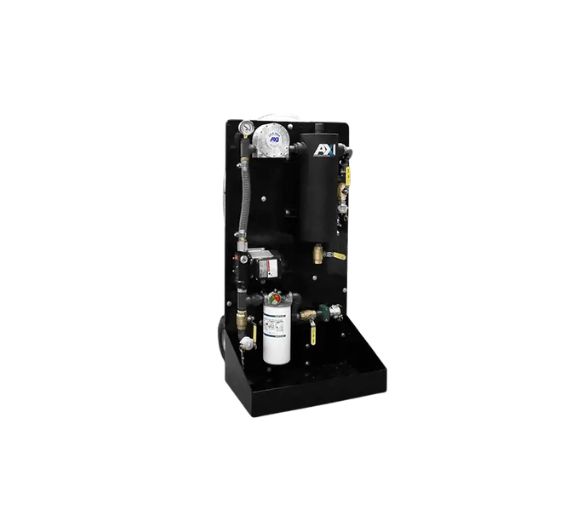
MTC-1000 mobile fuel polishing system — cart-mounted 15 GPM portable diesel tank cleaner with mechanical water separator, 1/2 HP rotary vane pump, LG-X 3000 inline magnetic conditioner, multi-stage fine filter with pressure gauge, 1-inch cam and groove connections, and spill containment tray
Fuel Polishing System
900 GPH Flow | AC Mains Powered | Multi-Stage Filtration
Fuel Management Systems · Fuel Polishing · Diesel Tank Cleaning

MTC-1000 Mobile Fuel Polishing System – Cart-Based 900 GPH Diesel and Bio-Fuel Tank Cleaner with Multi-Stage Filtration and Magnetic Conditioning

The MTC-1000 mobile fuel polishing system is a cart-mounted, AC-powered industrial unit engineered to eliminate water, sludge, microbial contamination, and particulate matter from diesel and bio-fuel storage tanks. Delivering a nominal flow rate of 15 GPM / 900 GPH, the system processes fuel through a three-stage cleaning circuit comprising a mechanical water separator, an LG-X 3000 inline magnetic conditioner, and a secondary spin-on fine filter selectable from 3, 10, or 25 microns — including water block options. Its cart-based design with locking 1-inch cam and groove connections, 25-foot hoses, and a built-in spill containment tray makes it a fully self-contained polishing unit capable of servicing multiple tanks across a site in a single maintenance session.

900 GPH Flow Rate
120 / 230V Power Supply
3µ – 25µ Filtration Rating
160 lbs Unit Weight

The MTC-1000 is an industrial-grade mobile fuel polishing system designed to tackle one of the most common causes of equipment failure in facilities that rely on stored diesel — degraded, contaminated fuel that breaks down injection systems and causes unplanned downtime. Powered from a standard AC mains supply and mounted on a wheeled cart for site mobility, the system draws fuel through a staged cleaning circuit that first separates free water and bulk sludge via a mechanical water separator, then conditions the fuel through an inline magnetic stage that captures ferrous particles and metal fines, and finally passes it through a precision-rated spin-on fine filter to achieve the cleanliness standard required for modern diesel injection systems. Its bypass mode allows operators to clear the worst contamination from a tank before engaging the fine filter — protecting filter life and reducing operating cost on heavily fouled tanks. With 25-foot hoses, locking cam and groove connections, and a spill containment tray, the MTC-1000 is ready for demanding, real-world fuel maintenance work across marine, industrial, and power generation applications.

  • Multi-Stage Fuel Filtration for Complete Contamination Removal: The MTC-1000 processes fuel through three distinct cleaning stages during fine filtration mode. The primary mechanical water separator first removes free water and bulk particulate contamination — the heaviest contaminants that accumulate at the bottom of diesel storage tanks. Fuel then passes through the LG-X 3000 inline magnetic conditioner, which captures ferrous particles that mechanical filtration alone cannot intercept. Finally, the secondary spin-on fine filter — available in 3, 10, or 25 micron ratings, as well as 3 and 10 micron water block variants — removes remaining fine particulate and, in the water block configuration, prevents both free and emulsified water from passing downstream. This three-stage sequence ensures fuel leaving the system consistently meets cleanliness codes required for reliable diesel engine and injection system performance.
  • Cart-Based Portable Design for Multi-Tank Site Servicing: The MTC-1000 is built on a wheeled cart platform, allowing a single operator to move the system between fuel tanks across a site without mechanical handling equipment. The cart design keeps all components — pump, filters, gauges, hoses, and the spill containment tray — organized as a single transportable unit that can be rolled to each tank location and connected within minutes. The 25-foot clear suction hose and 25-foot discharge hose provide generous reach to service tanks in confined plant rooms, below-deck spaces, and storage yards where access is limited. Once servicing of one tank is complete, the system drains and stores cleanly for rapid deployment at the next location.
  • 1/2 HP Rotary Vane Pump Rated for 15 GPM / 900 GPH Continuous Operation: The MTC-1000 is powered by a 1/2 HP rotary vane pump that delivers a steady 15 GPM / 900 GPH nominal flow rate under AC mains power, processing up to 7,200 gallons in an eight-hour run and up to 21,600 gallons over a 24-hour period. The rotary vane design provides consistent flow at the system's working pressures and is well suited to the high-cycle recirculation demands of large-tank fuel polishing work. The pump is capable of a 15-foot primed vertical suction lift or a 100-foot horizontal run on primed lines greater than 1 inch in diameter, giving it the reach required to draw fuel from deep storage tanks or sumps. The maximum operating fluid viscosity of 5 cSt ensures compatibility with the full range of diesel and bio-diesel fuel grades used across marine and industrial applications.
  • Locking Cam and Groove Connections for Fast, Leak-Free Hose Management: All inlet and outlet connections on the MTC-1000 use 1-inch locking cam and groove couplings — the same style of industrial quick-connect fittings used in commercial fuelling operations. These couplings allow the suction and discharge hoses to be connected and disconnected rapidly without tools, while the locking mechanism ensures that hoses cannot pull free during operation even when the pump is generating suction or discharge pressure. The transparent 25-foot suction hose allows the operator to monitor fuel flow visually throughout the polishing process, observing the condition of the fuel and confirming that the pump is primed and delivering a steady, uninterrupted flow before committing to a full polishing run.
  • Fine Filter Bypass Capability for Phased Polishing and Filter Protection: A key operational advantage of the MTC-1000 is its fine filter bypass mode, which routes fuel through the mechanical water separator only — bypassing the secondary fine filter entirely. This mode is used during the initial phases of polishing to remove bulk free water, heavy sludge, and large particulate from severely contaminated tanks without loading or prematurely blocking the more expensive spin-on fine filter cartridge. By systematically removing the worst contamination first, the bypass mode extends fine filter service life significantly on tanks that have not been maintained for extended periods, reducing consumable costs and the number of filter changes required to complete a full polishing cycle.
  • LG-X 3000 Inline Magnetic Conditioner for Enhanced Fuel Quality: Positioned between the mechanical water separator and the secondary fine filter, the LG-X 3000 inline magnetic conditioner uses a focused magnetic field to attract, cluster, and retain ferrous particulate and metallic contamination that passes through the primary separator but is too fine to be captured by coarser mechanical filtration. Magnetic conditioning also disrupts the molecular clustering behaviour associated with fuel aging and long-term bio-diesel storage, helping to maintain fuel combustibility and reduce the rate of further fuel degradation between polishing cycles. The inline installation adds no flow restriction to the system and requires no replacement parts or consumable maintenance beyond the routine system inspection schedule.
  • Spill Containment Tray and Integrated Safety Features: The MTC-1000 incorporates a built-in spill containment tray that catches incidental fuel drips and spills during hose connection and disconnection, filter servicing, and water separator draining. Vacuum and pressure gauges provide continuous real-time monitoring of system condition throughout each polishing session — the vacuum gauge indicates suction-side restrictions such as a clogged separator or a blocked inlet, while the pressure gauge on the fine filter housing signals when the secondary filter element has reached its capacity and requires replacement. Inlet and outlet ball valves allow safe isolation of the system before any maintenance procedure, and the water separator drain valve allows accumulated water and sludge to be discharged without disassembling the primary filter housing.
  • Marine Vessel and Commercial Harbour Fuel Tanks: Diesel fuel aboard vessels and within harbour fuel installations is continuously exposed to conditions that accelerate contamination — humidity, temperature cycling, condensation, and tank movement all contribute to water ingress, microbial growth, and sludge formation. The MTC-1000's 900 GPH flow rate allows it to service large-capacity vessel and bunker tanks within a practical maintenance window, making it well suited to routine servicing of commercial fishing fleets, offshore support vessels, ferries, and harbour fuel storage tanks. The cam and groove connections allow it to integrate cleanly with existing tank access points, and the 25-foot hoses provide the reach needed to service tanks in deep bilge spaces or shore-side tank farms.
  • Standby Generator and Data Centre Fuel Tanks: Standby diesel generators at hospitals, data centres, telecommunications infrastructure sites, and critical government facilities must start and run reliably under full load during power failure events — often after weeks or months of inactivity. Fuel sitting in day-tanks and bulk storage tanks during standby periods is particularly vulnerable to water contamination, microbial growth, and sludge accumulation. Routine polishing with the MTC-1000 as part of a scheduled preventive maintenance programme keeps standby fuel supplies in a reliably clean and combustible condition, reducing the risk of fuel filter blockage or injection system failure during a critical starting event.
  • Industrial Bulk Fuel Storage and Fleet Fuelling Facilities: Large industrial operations, fleet fuelling depots, and bulk fuel distributors maintain significant diesel storage volumes that are continuously being replenished and drawn down. Each fuel delivery introduces the potential for contamination, and storage tanks accumulate water, sludge, and biological matter between maintenance intervals. The MTC-1000's high throughput rate allows it to service large-volume industrial tanks quickly during planned shutdown windows, and its cart-based mobility means a single unit can be shared across multiple tanks within a facility, maximising return on investment for organisations managing several storage points simultaneously.
  • Construction Sites and Remote Field Operations: Construction projects and remote resource extraction operations store diesel fuel in portable tanks, bowsers, and above-ground storage containers that are vulnerable to contamination from condensation, field dust, contaminated deliveries, and improper handling. Fuel quality problems at remote sites are particularly costly because replacement parts for damaged injection systems and downtime for excavators, generators, and haul trucks are expensive and logistically difficult to resolve. The MTC-1000 allows site fuel managers to maintain polished, clean fuel at the point of storage before it is dispensed into critical equipment, preventing contamination-related breakdowns that cause delays and cost overruns.
  • Agricultural and Off-Highway Equipment Fuel Stores: Agricultural operations and civil earthmoving contractors maintain on-site diesel storage in bulk tanks that supply tractors, harvesters, excavators, and other off-highway equipment. These tanks are typically serviced infrequently and accumulate water and biological contamination between fill cycles. The MTC-1000 provides an efficient, mobile solution for periodic polishing of these tanks, ensuring that fuel dispensed to working equipment is free from the contamination that causes premature fuel filter blockages and injector damage — maintenance failures that are particularly disruptive during time-sensitive harvesting or excavation operations.
  • Fuel Polishing Service Contractors and Mobile Maintenance Teams: Mobile fuel polishing service contractors who provide scheduled tank maintenance services to multiple clients benefit directly from the MTC-1000's combination of high throughput, cart-based mobility, and flexible filter configuration. The ability to switch between bypass mode and fine filtration mode — and to select from a range of secondary filter micron ratings to suit each tank's specific contamination profile — allows a single MTC-1000 unit to handle the full spectrum of tank conditions encountered across a diverse customer base, from lightly contaminated generator tanks to severely degraded marine fuel stores.

Specifications listed below apply to the standard MTC-1000 mobile fuel polishing system. Replacement filter elements are available separately — contact us with your requirements for part numbers and availability.

Parameter Specification
Nominal Flow Rate 15 GPM / 900 GPH (56.8 LPM / 3,407 LPH)
Processing Capacity (8-hour shift) 7,200 gallons (27,255 litres)
Processing Capacity (24-hour period) 21,600 gallons (81,765 litres)
Pump Type 1/2 HP Rotary Vane Pump
Power Supply 120V/60Hz/15A or 230V/50Hz/15A*
Primary Filter Mechanical Water Separator
Secondary Filter Options 1, 3, 10, or 25µ Fine Filter or 3, 10µ Water Block
Secondary Filter (Standard Issue) 3µ Fine Filter (Part No. FF-3)
Fuel Conditioner LG-X 3000 Inline Magnetic Conditioner
Plumbing Material Black Iron
Inlet Port 1" Cam & Groove
Outlet Ports 1" Cam & Groove (Discharge Port 1 & Port 2)
Suction Hose Clear, 25 ft (7.6 m), 1" Diameter
Discharge Hose 25 ft (7.6 m), 1" Diameter
Suction Capability (Primed) 15 ft (4.6 m) vertical lift or 100 ft (30.5 m) horizontal run
Maximum Fluid Viscosity 5 cSt
Operating Temperature Range 41–104°F (5–40°C)
Dimensions (H × W × D) ≈ 48" × 22.5" × 25" (122 × 57 × 63 cm)
Weight ≈ 160 lbs (72.6 kg)
Compatible Fuels Diesel and Bio-Fuel Blends (flash point ≥ 100°F / 37.8°C)
Fine Filter Change Indicator 20–25 PSI / red zone on pressure gauge

*At 50 Hz, nominal flow rate decreases from 15 GPM / 900 GPH to 12 GPM / 720 GPH.

How the MTC-1000 Mobile Fuel Polishing System Works

Operation begins by connecting the MTC-1000 to a compatible AC mains power supply — either 120V/60Hz or 230V/50Hz — and ensuring the system is properly grounded for operator safety. The clear 25-foot suction hose is connected to the 1-inch cam and groove inlet port and positioned so its end reaches the deepest point of the fuel storage tank, drawing from where water and sludge accumulate most heavily. The discharge hose is attached to the appropriate outlet port depending on the intended operating mode. Before starting, the entire suction side — including the hose, primary water separator, plumbing, and pump — must be fully primed with fuel. The pump is not self-priming and must not be run dry, as operating without fuel will cause pump damage.

For tanks with significant contamination, a three-phase polishing process is recommended. In Phase 1, the system is configured in bypass mode — the discharge hose routes to a separate waste container rather than back to the tank — allowing bulk free water and bottom sludge to be pumped out and discarded without recirculating contamination through the system. In Phase 2, still in bypass mode, the discharge hose is returned to the tank and fuel is recirculated through the mechanical water separator to continue removing water, sludge, and large particulate while protecting the fine filter. The vacuum gauge monitors suction-side condition throughout both bypass phases, signalling if the water separator becomes clogged and requires draining via the drain valve.

Phase 3 transitions the system to fine filtration mode by connecting the discharge hose to the second outlet port, which routes fuel through the high-efficiency spin-on fine filter after the separator and magnetic conditioner stages. The pressure gauge between the pump and the fine filter provides real-time monitoring of filter condition — when pressure reaches 20 to 25 PSI or the needle enters the red zone, the spin-on filter element should be replaced before the next session. Once polishing is complete and clean fuel samples confirm acceptable tank cleanliness, the pump is switched off, the system is drained and stored, and the spill containment tray captures any residual drips during hose disconnection and filter servicing.

Technical FAQ

Common Questions Answered

Can't find your answer? Contact our engineers →

The MTC-1000 is designed for use with diesel fuel and bio-diesel blends. It must not be used with gasoline, petrol, or any other flammable liquid with a flash point below 100°F (37.8°C) — using the system with such fluids presents an immediate fire and explosion hazard. Always verify the flash point of the fuel in question before connecting and operating the system, particularly when working with unfamiliar bio-blend formulations or fuels from mixed-use storage tanks.

The MTC-1000 operates at a nominal flow rate of 15 GPM (900 GPH / 56.8 LPM). This equates to approximately 7,200 gallons (27,255 litres) per 8-hour shift and up to 21,600 gallons (81,765 litres) over a 24-hour period. When operating on a 50 Hz supply, the flow rate reduces to 12 GPM / 720 GPH. For tanks with large storage volumes, multiple polishing passes can be completed within a standard maintenance window, achieving progressively cleaner fuel with each circulation through the three-stage filtration circuit.

Fine filters (available in 1µ, 3µ, 10µ, and 25µ ratings) remove particulate contamination down to their rated micron level and are the recommended starting choice for tanks with predominantly particulate contamination. Water block filters (3µ WB-3 and 10µ WB-10) provide the same particulate filtration performance but are constructed with a hydrophobic media that actively prevents free and emulsified water from passing through the element. For tanks with combined particulate and water contamination, the recommended practice is to begin with a coarser fine filter for initial bulk removal passes, then complete the final polishing passes with a 3µ water block cartridge to achieve the highest attainable fuel cleanliness standard.

Bypassing the fine filter during the initial polishing phases removes bulk free water, heavy sludge, and coarse particulate from the tank before they reach and load the secondary fine filter cartridge. Fine filter elements are precision-rated consumables — using them to capture large volumes of gross contamination significantly shortens their service life and increases operating cost per tank service. The bypass mode allows the mechanical water separator to handle the heaviest contamination first, so that when the system is switched to fine filtration mode, the spin-on filter is only asked to deal with residual fine contamination that the separator cannot capture. This phased approach extends filter life, reduces consumable expenditure, and improves overall polishing efficiency, particularly on tanks that have not been maintained for extended periods.

The MTC-1000 operates on either 120V/60Hz/15A (standard North American mains) or 230V/50Hz/15A (international mains). The system must be properly grounded before operation — operator safety depends on correct earthing of the entire unit. When operating on a 50 Hz supply, the nominal flow rate decreases from 15 GPM / 900 GPH to 12 GPM / 720 GPH. A suitable grounded mains outlet at the appropriate voltage is the only external utility required; the system does not require any external compressed air, water, or additional services to operate.

The pressure gauge on the MTC-1000 is positioned between the pump outlet and the secondary fine filter housing. As the spin-on filter element accumulates contamination and begins to restrict fuel flow, the pressure reading rises progressively during operation. When the gauge reaches 20 to 25 PSI, or when the needle enters the red zone on the gauge dial, the fine filter element has reached its capacity and should be replaced before continuing or commencing the next polishing session. If a new or freshly installed filter element causes an immediate pressure spike at start-up, this indicates a restriction on the discharge side of the system — such as a closed outlet ball valve or a blocked discharge line — rather than a filter condition issue, and should be investigated separately before operating the pump.

Free Technical Consultation

Get Your Datasheet
+ Quote in 24 Hours

Our engineers will confirm the correct filter configuration, replacement cartridge part numbers, and system accessories for your fuel polishing application — and provide full technical documentation and a competitive quote tailored to your tank size, fuel type, and operational requirements.

  • Response guaranteed within 24 hours
  • Full technical datasheet included
  • Filter selection and application guidance
  • OEM & bulk pricing available

Quick Quote Request

No spam ever · Response within 24 hours

Our Product Partners
Enovation Controls FW Murphy Production Controls Austart Air Starters MCS Mobile Control Systems AXI International Pacbrake Engine Exhaust Senquip Telemetry Enovation Controls FW Murphy Production Controls Austart Air Starters MCS Mobile Control Systems AXI International Pacbrake Engine Exhaust Senquip Telemetry