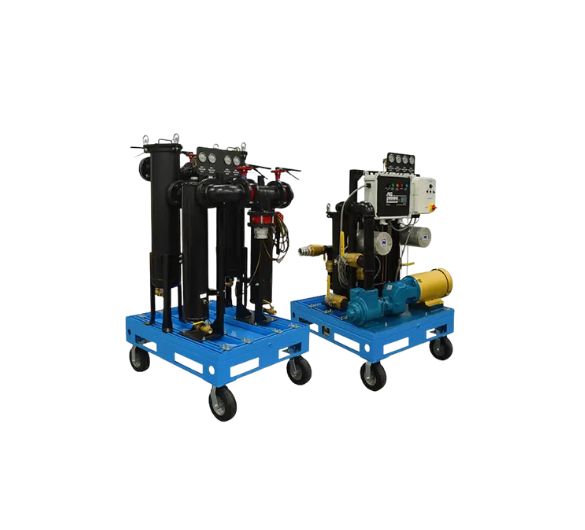
MTC HC-150 high capacity mobile fuel polishing system — dual-skid 10–150 GPM VFD-controlled diesel tank cleaner with bag filter vessel, dual mechanical water separators, magnetic fuel conditioners, cartridge fine filter vessels, and SFC80 smart filtration controller
High Capacity Fuel Polishing System
Up to 150 GPM Flow | VFD-Controlled Pump | SFC80 Smart Controller
Fuel Management Systems · High Capacity Fuel Polishing · Industrial Diesel Tank Cleaning

MTC HC-150 High Capacity Mobile Fuel Polishing System – 10 to 150 GPM Dual-Skid VFD-Controlled Diesel Tank Cleaner with Multi-Stage Filtration and SFC80 Smart Safety Alarms

The MTC HC-150 high capacity mobile fuel polishing system is a dual-skid, industrial-grade unit engineered to remove water, sludge, and particulate contamination from diesel and bio-fuel storage tanks at throughput levels of up to 150 GPM (567.8 LPM). Powered by a 10 HP sliding vane pump on a 480V/60Hz/3-phase supply with a built-in Variable Frequency Drive (VFD) for precise flow rate control, the system processes fuel through a comprehensive dual-skid cleaning circuit. The Pre-Filter Skid delivers bulk contamination removal through a primary bag filter vessel (1–800µ) and dual FP-90 mechanical water separators. The Pump Skid handles precision polishing via cartridge fine filter vessels (2–30µ particulate, 10–30µ water block, or 3–10µ micro-glass), dual LG-X 4000 inline magnetic fuel conditioners, and the SFC80 Smart Filtration Controller with integrated High Water, High Vacuum, and High Pressure alarms and remote pendant operation. Purpose-built for high-throughput fuel maintenance at demanding industrial, marine, and critical power sites.

150 GPM Max Flow Rate
10 HP Sliding Vane Pump
1µ – 800µ Primary Filter Range
Dual Skid Portable Design

The MTC HC-150 is a purpose-built high capacity fuel polishing system designed for operations that demand maximum-throughput cleaning of large diesel and bio-fuel storage tanks. Mounted on two independently transportable skids for ease of movement between service locations, the system drives fuel through a six-stage cleaning circuit spanning both skid modules. The Pre-Filter Skid handles bulk decontamination through a primary bag filter vessel and dual mechanical water separators, while the Pump Skid takes over for precision polishing via absolute-rated cartridge fine filter vessels and dual inline magnetic fuel conditioners. The SFC80 Smart Filtration Controller provides automated three-channel alarm monitoring, operator indicator displays, and remote pendant control — making the HC-150 a capable and self-protecting system for high-volume fuel quality management at industrial facilities, marine installations, power generation sites, and large-scale commercial tank farms. Locking 3-inch cam and groove inlet connections, a 2.5-inch discharge port, and a 25-foot clear suction hose allow rapid deployment at any site with 480V/3-phase power available.

  • 10 HP Sliding Vane Pump with VFD Flow Rate Control — Up to 150 GPM: The MTC HC-150 is driven by a 10 HP sliding vane pump connected to a 480V/60Hz/3-phase electrical supply, delivering a maximum throughput of 150 GPM (567.8 LPM) at full pump speed. Unlike fixed-speed systems, the HC-150 incorporates a Variable Frequency Drive (VFD) controller that allows the operator to adjust pump output across the full range of 10 to 150 GPM by dialling the frequency between 10 Hz and 60 Hz. Flow rate scales directly with frequency at a ratio of 2.5 GPM per Hz, enabling precise control suited to each phase of the polishing cycle — slower speeds during initial water and sludge extraction to minimise tank agitation, progressively higher rates during recirculation and fine filtration phases to maximise throughput efficiency. The sliding vane pump design provides consistent, pulse-free flow under varying differential pressures across the filter stages, supporting stable operation throughout the full polishing cycle.
  • Dual-Skid Portable Design for Maximum Site Flexibility: The HC-150 is constructed as two independent skid modules — the Pre-Filter Skid and the Pump Skid — each sharing an identical footprint of approximately 59 × 36 × 45 inches. This dual-skid architecture serves a practical purpose beyond simply housing the system's components: each skid can be transported, positioned, and relocated independently, allowing the system to pass through standard facility doorways, be loaded onto service vehicles separately, and be placed in confined equipment rooms where a single large-footprint unit could not fit. The two skids connect via a suction hose linking the Pre-Filter Skid outlet to the Pump Skid inlet during operation, and disconnecting takes no more time than releasing the cam and groove couplings at each connection point. This portability makes the HC-150 genuinely mobile in the operational sense, enabling a single crew to service multiple tanks at different locations within the same facility or across multiple sites without major handling infrastructure.
  • Multi-Stage Fuel Filtration Across Both Skid Modules: Fuel follows a structured contamination-reduction sequence across the two skids. On the Pre-Filter Skid, a primary bag filter vessel equipped with a liner basket accepts interchangeable filter bags from 1 to 800 microns, enabling the operator to match the coarseness of the primary filtration stage to the contamination severity at each phase of the polishing cycle. Progressive reduction in bag micron ratings — from coarse during Phase 1 and 2 to finer ratings as bulk contamination is cleared — ensures that the upstream stages absorb the maximum possible loading before fuel advances to the Pump Skid. There, dual cartridge fine filter vessels accept absolute-rated secondary elements in particulate (2–30µ), water block (10–30µ), or micro-glass (3–10µ) configurations, providing the final, precision filtration step required to bring stored fuel into compliance with injection system specifications and regulatory cleanliness codes.
  • Dual FP-90 Mechanical Water Separators with Independent Side Isolation: The Pre-Filter Skid incorporates two FP-90 mechanical water separators — one serving each filter side — positioned between the primary bag filter and the outlet that connects to the Pump Skid. Each separator mechanically extracts free water and accumulated sludge from the fuel stream, directing separated water to dedicated drain valves for controlled disposal rather than allowing it to advance to the secondary cartridge filter stage. Water detection sensor probes inside each separator continuously monitor water accumulation levels and trigger High Water alarms through the SFC80 controller when thresholds are exceeded, initiating automatic pump shutdown before contaminated fuel can reach the downstream filter elements. Butterfly isolation valves on each side of the Pre-Filter Skid allow one separator to be taken out of service and drained during operation without stopping the entire polishing cycle — a significant advantage during extended high-volume polishing on tanks with heavy water ingress where separator servicing intervals may be short.
  • Dual LG-X 4000 Inline Magnetic Fuel Conditioners: Every litre of fuel that passes through the Pump Skid flows through two LG-X 4000 inline magnetic conditioners, each installed in series within the secondary filter circuit. The strong magnetic field generated by each conditioner acts on the charge state of hydrocarbon molecules and ferrous micro-particles suspended in the fuel, reducing the tendency of particulate to reagglomerate into new sludge deposits and promoting a more homogeneous, stable fuel condition leaving the system. Over multiple polishing cycles, the conditioning effect supports reduced fouling rates in the storage tank environment itself, as well as on injector tips, fuel filters, and other downstream fuel system components. Because the LG-X 4000 conditioners are entirely passive — containing no moving parts and requiring no external power input — they contribute continuous fuel conditioning to every polishing pass at zero additional operating cost and with no maintenance requirement beyond periodic connection inspection.
  • SFC80 Smart Filtration Controller with Integrated Safety and Alarm System: The SFC80 Smart Filtration Controller on the Pump Skid serves as the HC-150's operational brain, managing pump activation through the VFD, monitoring system health across three independent alarm channels, and providing the operator with a clear picture of system status through a PLC with LCD display. Three alarm channels protect the system continuously during operation: the High Water alarm triggers pump shutdown when water sensor probes detect excessive accumulation in either FP-90 water separator; the High Vacuum alarm activates at 16 inches HG on the pump suction side when primary bag filter loading restricts inlet flow to the shutdown threshold; and the High Pressure alarm fires at 22 PSI discharge-side pressure when secondary cartridge filter elements approach saturation. The SFC80's front panel provides a Pump Control Selector Switch for Manual and Remote operating modes, separate indicator lights for system power, pump running status, and active alarms, and an Alarm Reset push button that requires positive operator acknowledgement before the pump can restart after any alarm shutdown — ensuring the polishing cycle cannot resume in a condition that would compromise fuel quality or risk system damage.
  • Filter Isolation Capability for Uninterrupted Servicing: Both the Pre-Filter Skid and the Pump Skid are engineered with Side 1 and Side 2 filter isolation, enabling one filter side on each skid to be taken offline for element servicing while the other side continues processing fuel. On the Pre-Filter Skid, independent butterfly isolation valves control flow through each bag filter vessel and water separator pair. On the Pump Skid, dedicated isolation ball valves separate each secondary cartridge filter vessel from the main flow path. This dual-sided isolation architecture means that neither primary bag filter changes nor secondary cartridge replacements require a complete system shutdown, allowing polishing to continue uninterrupted on large or critically important tanks where extended service pauses are operationally costly. When a High Vacuum or High Pressure alarm indicates that a specific filter side requires attention, the operator can isolate that side, service it, and return it to operation — all without stopping fuel flow through the active filter path.
  • Remote Pendant Operation for Flexible On-Site Control: When the SFC80 controller's selector switch is placed in AUTO mode, the integrated remote pendant switch allows the operator to start and stop the pump from a distance without returning to the skid-mounted controller panel. This is operationally valuable when the HC-150 is positioned at a distance from the tank access point, when the operator needs to monitor suction hose positioning or observe fuel flow during startup at the tank opening, or when the system is deployed in a confined equipment room where continuous proximity to the Pump Skid controller is impractical during a long polishing cycle. The SFC80 continues to monitor all three alarm channels and execute automatic safety shutdowns independently of the pendant state, providing full protection regardless of the operator's position on site during operation.
  • Fine Filter Bypass Capability for Cost-Effective Phased Tank Cleaning: A dedicated bypass mode on the HC-150 routes fuel exclusively through the Pre-Filter Skid's bag filter vessel and dual water separators, completely bypassing the Pump Skid's secondary cartridge fine filter elements. Engaging precision absolute-rated cartridge elements on a tank with heavy free water, sludge, or coarse particulate contamination would cause rapid element saturation before meaningful fuel cleanliness improvement is achieved — generating unnecessary element replacement cost and repeated service interruptions in the early stages of polishing. The bypass mode allows Phases 1 and 2 of the polishing cycle to absorb the worst contamination through the lower-cost bag filter elements and mechanical water separators, dramatically extending secondary cartridge element service life when they are finally engaged in Phase 3. On chronically contaminated large tanks, the economic and operational benefit of this phased approach can be substantial, reducing both total filter element consumption and the number of polishing interruptions per tank cleaning cycle.
  • Locking Cam and Groove Connections with Large-Diameter Hoses for High-Volume Throughput: The MTC HC-150's inlet port uses a 3-inch cam and groove connection, and the outlet port uses a 2.5-inch cam and groove coupling — both sized to handle the system's maximum 150 GPM flow rate without generating restrictive pressure drop in the connection hardware. The supplied 25-foot clear suction hose with a 3-inch diameter allows the operator to reach tank bottom access points from a working distance, and the transparent hose wall provides a direct visual check of pump prime status and fuel flow quality during startup and operation. The 25-foot, 2.5-inch discharge hose offers sufficient reach to direct return fuel to the target tank zone without requiring additional hose extensions in most standard tank service configurations. All cam and groove couplings are locking style, resisting accidental disconnection during operation caused by hose movement, pump vibration, or inadvertent contact from site personnel or equipment.
  • Large-Scale Industrial Fuel Depots and Bulk Storage Facilities: Petrochemical plants, fuel terminals, and bulk diesel storage operations maintain tanks measured in tens of thousands of litres that require regular polishing to meet quality standards and prevent microbial growth, sludge accumulation, and water ingress from degrading fuel stocks. The HC-150's maximum 150 GPM throughput allows a meaningful volume of stored fuel to be processed within practical service windows, making it the appropriate tool for large-tank applications where lower-capacity polishing systems would require impractically long run times to complete a full cleaning cycle. Its dual-skid design supports placement in congested tank farm environments where access routes and working spaces are constrained by existing infrastructure.
  • Power Generation Facilities and Standby Generator Infrastructure: Power stations, hospitals, data centres, and emergency service facilities rely on large diesel reserves in day-tanks and bulk storage vessels to fuel standby generators that must perform reliably during extended grid outages. Long storage periods promote water condensation, oxidation byproducts, and microbial contamination that can compromise fuel combustibility and block injection components at the moment of demand. The HC-150's phased polishing approach — bulk water and sludge removal through the Pre-Filter Skid followed by precision fine filtration on the Pump Skid — restores stored diesel to operational specification without requiring tank drainage, allowing critical facilities to maintain proactive fuel quality assurance programmes on their full reserve capacity without disrupting generator readiness.
  • Marine Vessels, Ports, and Shipyard Fuel Management: Commercial vessels, passenger ferries, offshore support vessels, and port fuel bunkering facilities accumulate water and microbial contamination in their diesel reserves through condensation cycles, deck seal deterioration, and delivery contamination during bunkering operations. The HC-150's high throughput makes it well suited to servicing the large day-tank and main storage tank volumes carried by commercial vessels during scheduled port calls or dry-dock maintenance periods. Its portable dual-skid construction allows the system to be moved aboard vessels via gangway or crane and positioned in fuel storage areas, while the SFC80's remote pendant enables flexible operation from a position that may be separate from the pump skid location within the machinery space.
  • Mining, Construction, and Remote Heavy Plant Operations: Large mining operations, remote construction camps, and infrastructure projects run extensive fleets of heavy plant equipment — excavators, haul trucks, drilling rigs, and generator sets — from bulk diesel reserves that may receive infrequent deliveries and endure long storage periods between high consumption phases. Each delivery and storage period introduces contamination risk, and the consequences of fuel-related equipment failure in remote locations — both in terms of operational downtime and mobilisation cost for repair — are substantially higher than equivalent failures at established industrial sites. The HC-150's 150 GPM capacity allows a significant portion of bulk reserve volume to be polished during planned maintenance windows, and its VFD-adjustable flow rate supports careful initial sludge extraction before full-rate recirculation cleaning.
  • Offshore Platforms and Remote Energy Infrastructure: Offshore oil and gas platforms, floating production units, and remote renewable energy sites with diesel backup generation operate fuel-dependent equipment in environments where salt air, high humidity, and temperature cycling dramatically accelerate fuel degradation and microbial contamination rates. The cost and logistical complexity of mobilising maintenance resources to offshore or remote locations means that proactive fuel quality management — using a high-capacity system capable of fully processing tank volumes in a single planned maintenance visit — is operationally and economically preferable to reactive remediation after contamination-related failures. The HC-150's dual-skid configuration supports transport by supply vessel or helicopter freight, and its self-contained design with integrated alarms allows semi-attended operation during extended polishing cycles on remote sites with limited personnel.
  • Mobile Fuel Polishing Service Contractors Serving Large-Tank Clients: Professional fuel polishing service contractors operating across large client portfolios — utilities, industrial operators, port authorities, mining companies, and military bases — require a polishing system that can handle the tank volumes encountered at major facilities within commercially viable service durations. The HC-150's 150 GPM maximum throughput provides the high-volume processing capability that distinguishes a professional high-capacity service offering from a basic tank maintenance operation. The filter isolation capability, VFD flow control, phased bypass operation, SFC80 smart alarm system, and dual-skid transport flexibility combine to make the HC-150 a technically capable and operationally practical tool for full-service contractors managing complex multi-tank and multi-site fuel quality programmes.

Specifications listed below apply to the standard MTC HC-150 high capacity mobile fuel polishing system across both the Pre-Filter Skid and Pump Skid modules. Replacement filter bags and cartridge filter elements are available separately — contact us with your requirements for part numbers and availability.

Parameter Specification
Nominal Flow Rate 10–150 GPM (37.9–567.8 LPM)
Pump Type 10 HP Sliding Vane Pump
Power Supply 480V / 60Hz / 3-Phase
Flow Control Variable Frequency Drive (VFD) — 10 Hz to 60 Hz (25–150 GPM)
Primary Filter (Pre-Filter Skid) Bag Filter Vessel with Liner Basket (1–800µ Filter Bags)
Water Separator (Pre-Filter Skid) Dual FP-90 Mechanical Water Separators
Secondary Filter Options (Pump Skid) Cartridge Filter Vessels — 2–30µ Particulate, 10–30µ Water Block, or 3–10µ Micro-glass Filters
Fuel Conditioner (Pump Skid) Dual LG-X 4000 Inline Magnetic Conditioner
System Controller SFC80 Smart Filtration Controller with Safety and Alarm Features
Operating Modes Manual, Remote (Pendant), Bypass, Fine Filtration
Safety Alarms High Water, High Vacuum (16" HG), High Pressure (22 PSI)
Plumbing Material Black Iron
Inlet Port 3" Cam & Groove In
Outlet Port 2.5" Cam & Groove Out (Discharge Port 1 & Port 2)
Suction Hose Clear, 25 ft (7.6 m), 3" Diameter
Discharge Hose 25 ft (7.6 m), 2.5" Diameter
Suction Capability (Primed) 15 ft (4.6 m) vertical lift or 100 ft (30.5 m) horizontal run (lines > 2", primed)
Maximum Fluid Viscosity 5 cSt
Operating Temperature Range 41–104°F (5–40°C)
Dimensions — Pre-Filter Skid (H × W × D) ≈ 59" × 36" × 45" (150 × 91 × 114 cm)
Dimensions — Pump Skid (H × W × D) ≈ 59" × 36" × 45" (150 × 91 × 114 cm)
Weight — Pre-Filter Skid ≈ 850 lbs (385.5 kg)
Weight — Pump Skid ≈ 900 lbs (408.2 kg)
Compatible Fuels Diesel and Bio-Fuel Blends (flash point ≥ 100°F / 37.8°C)

How the MTC HC-150 High Capacity Mobile Fuel Polishing System Works

Operating the MTC HC-150 begins with positioning both skids at the service location and connecting the Pre-Filter Skid outlet to the Pump Skid inlet via the supplied suction hose. The 25-foot clear suction hose is then attached to the 3-inch cam and groove inlet of the Pre-Filter Skid and inserted into the storage tank, ideally fitted with a straight wand or angled pipe attachment to reach the lowest accessible point where settled water and sludge concentrate. Before starting the pump, the operator verifies that all inlet, outlet, and isolation butterfly valves on the Pre-Filter Skid and the appropriate ball valves on the Pump Skid are set correctly for the intended operating mode — Bypass or Fine Filtration — and that the entire suction circuit is primed with fuel before engaging the VFD-controlled pump motor.

During Phase 1, the system operates in Bypass Mode with the discharge hose directed into a separate waste container, drawing down at a low VFD-set flow rate (10–20 Hz) to remove bulk free water and heavy sludge from the tank bottom without agitating the settled contamination layer. The transparent suction hose provides a direct visual indicator of what the pump is drawing from the tank floor, allowing the operator to monitor the transition from water and sludge to predominantly fuel. Once the discharge stream has cleared, the pump is stopped, the water separators and hoses are drained into an appropriate waste container via the drain valves, and the system moves into Phase 2. In this phase, the discharge hose is returned to the fuel tank for recirculation, and the system continues in Bypass Mode at a higher flow rate — cycling tank fuel through the bag filter vessel and dual FP-90 water separators repeatedly to progressively remove residual coarse contamination. The SFC80 controller monitors both water separators continuously, automatically shutting down the pump if accumulated water levels reach the High Water alarm threshold during recirculation.

Phase 3 switches the system into Fine Filtration Mode by connecting the discharge hose to Discharge Port 2 on the Pump Skid and opening the secondary filter isolation ball valves, routing fuel through the absolute-rated cartridge fine filter vessels on its way back to the tank. The VFD is advanced to the desired operational flow rate — up to 150 GPM — for the precision polishing pass. The SFC80 now monitors both the upstream vacuum gauges for primary filter loading and the downstream pressure gauges for secondary filter saturation, triggering High Vacuum and High Pressure alarms respectively when either set of elements requires servicing. On both the primary and secondary filter stages, isolation on each side allows element changes to take place without stopping fuel flow through the active side. Polishing continues until clean fuel samples drawn from the water separator confirm that the tank contents have reached the target cleanliness specification. At that point, the pump is wound down through the VFD, the suction hose is purged, and the system is drained and prepared for transport to the next service location.

Technical FAQ

Common Questions Answered

Can't find your answer? Contact our engineers →

The MTC HC-150 is designed for use with diesel fuel and bio-diesel blends with a flash point at or above 100°F (37.8°C). It must not be operated with gasoline, petrol, or any other flammable liquid below this flash point threshold — doing so presents an immediate fire and explosion hazard. Always verify the flash point of the fuel before connecting and starting the system, particularly when working with bio-blend formulations or fuel from mixed-use storage tanks.

Flow rate is controlled through the Variable Frequency Drive (VFD) built into the Pump Skid's SFC80 controller panel. The sliding vane pump delivers approximately 2.5 GPM for every 1 Hz of VFD frequency, giving a practical operating range of 25 GPM at 10 Hz up to 150 GPM at 60 Hz. The frequency knob on the VFD can be adjusted while the pump is running to change throughput in real time. Lower speeds are recommended during Phase 1 sludge extraction to minimise tank agitation, while higher speeds suit the recirculation and fine filtration phases where maximum throughput efficiency is the priority.

The SFC80 monitors three independent safety channels. The High Water alarm activates when water detection sensor probes inside either FP-90 mechanical water separator detect excessive water accumulation, triggering automatic pump shutdown to protect secondary filter elements. The High Vacuum alarm fires at 16 inches HG on the pump suction side, indicating that the primary bag filter element has loaded to the point of restricting inlet flow. The High Pressure alarm activates at 22 PSI on the discharge side, signalling that secondary cartridge filter elements require replacement. All three alarms halt the pump and require both fault correction and pressing the Alarm Reset button before the system can restart.

The HC-150 comprises two separate skid modules — the Pre-Filter Skid for bulk contamination removal and the Pump Skid for precision polishing — each on an independent pallet base measuring approximately 59 × 36 × 45 inches. The dual-skid configuration allows each module to be transported, positioned, and relocated independently, making it practical to move through standard facility doorways, load onto service vehicles in two lighter lifts, and place in confined machinery rooms or tank rooms that a single large-footprint unit could not enter. Both skids connect via the supplied inter-skid suction hose during operation and disconnect in seconds for relocation between tanks or service sites.

Yes. Both skids incorporate Side 1 and Side 2 filter isolation, allowing one filter side on each skid to be taken offline for element servicing while the other side continues to process fuel. On the Pre-Filter Skid, independent butterfly isolation valves control each bag filter vessel and water separator pair. On the Pump Skid, dedicated isolation ball valves separate each secondary cartridge filter vessel from the main flow circuit. This means that neither primary bag filter changes nor secondary cartridge replacements require a complete system shutdown — polishing can continue uninterrupted through the active filter side while the other side is serviced and returned to service.

The primary bag filter vessel accepts bags from 1 to 800 microns using part numbers PFB-150-1 through PFB-150-800. The secondary cartridge fine filter vessels accommodate 2µ and 10µ particulate elements (618-2-W, 618-10-W), 10µ and 30µ water block elements (WA618-10-W, WA618-30-W), 30µ particulate (618-30-W), and 3µ, 7µ, and 10µ micro-glass elements (G618-3-SR, G618-7-SR, G618-10-SR). All secondary cartridge filters are absolute-rated unless otherwise noted, ensuring consistent and verifiable filtration efficiency for fuel cleanliness compliance. Contact our technical team to confirm the correct filter selection for your specific fuel type, contamination profile, and target cleanliness specification.

Free Technical Consultation

Get Your Datasheet
+ Quote in 24 Hours

Our engineers will confirm the correct filter configuration, replacement bag and cartridge part numbers, and system accessories for your high capacity fuel polishing application — and provide full technical documentation and a competitive quote tailored to your tank size, fuel type, power supply specification, and operational environment.

  • Response guaranteed within 24 hours
  • Full technical datasheet included
  • Filter selection and application guidance
  • OEM & bulk pricing available

Quick Quote Request

No spam ever · Response within 24 hours

Our Product Partners
Enovation Controls FW Murphy Production Controls Austart Air Starters MCS Mobile Control Systems AXI International Pacbrake Engine Exhaust Senquip Telemetry Enovation Controls FW Murphy Production Controls Austart Air Starters MCS Mobile Control Systems AXI International Pacbrake Engine Exhaust Senquip Telemetry