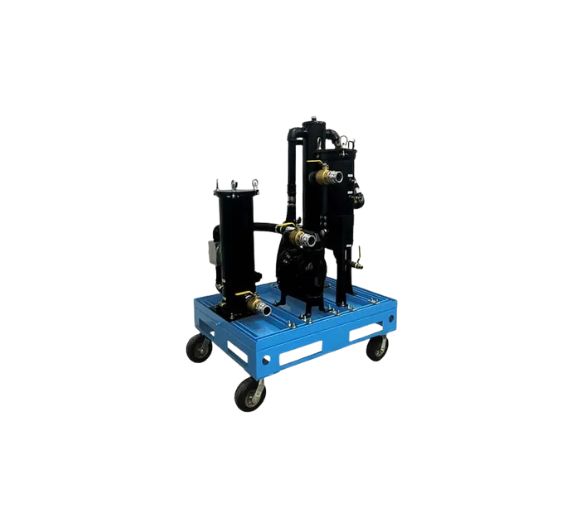
The MTC HC-50 high capacity mobile fuel polishing system is a skid-mounted, industrial-grade unit engineered to remove water, sludge, and particulate contamination from diesel and bio-fuel storage tanks without requiring an electrical power supply. Delivering a flow rate of 25–75 GPM (94.6–283.9 LPM) via an integrated air-driven double diaphragm pump (25–50 SCFM @ 90 PSI), the system routes fuel through a comprehensive multi-stage cleaning circuit comprising a bag filter vessel (1–800µ) for primary bulk removal, an FP-90 mechanical water separator, an LG-X 4000 inline magnetic fuel conditioner, and a cartridge fine filter vessel accepting 2–30 micron particulate, 10–30 micron water block, or 3–10 micron micro-glass elements. Optionally controlled by the SFC50 Smart Filtration Controller with integrated High Water, High Vacuum, and High Pressure alarms and remote pendant operation, the MTC HC-50 is purpose-built for reliable, high-throughput fuel maintenance at demanding industrial and marine sites.
The MTC HC-50 is a purpose-built high capacity fuel polishing system designed for operations that need effective, high-throughput cleaning of diesel and bio-fuel storage tanks at sites where compressed air is available and electrical supply is limited, unreliable, or hazardous. Mounted on a compact, wheeled skid for easy relocation between tank service points, the system drives fuel through a four-stage cleaning circuit — a bag filter vessel and dedicated mechanical water separator for initial bulk decontamination, an inline magnetic fuel conditioner for ongoing hydrocarbon stabilisation, and a high-efficiency cartridge fine filter for final particulate and free-water polishing. An optional SFC50 Smart Filtration Controller adds three-channel safety alarm monitoring and automatic pump shutdown protection, along with remote pendant operation for flexible on-site control. Locking 2-inch cam and groove connections, a clear 25-foot suction hose, and a full-length discharge hose make the HC-50 ready to deploy at any tank service location with minimal setup time.
Specifications listed below apply to the standard MTC HC-50 high capacity mobile fuel polishing system. Replacement filter bags and cartridge filter elements are available separately — contact us with your requirements for part numbers and availability.
| Parameter | Specification |
|---|---|
| Nominal Flow Rate | 25–75 GPM (94.6–283.9 LPM) |
| Pump Type | Air-Driven Double Diaphragm Pump |
| Power Supply | Air Powered — 25–50 SCFM @ 90 PSI via 1/2" Air Hose Connection |
| Primary Filter | Bag Filter Vessel with Liner Basket (1–800µ Filter Bags) |
| Water Separator | FP-90 Mechanical Water Separator |
| Secondary Filter Options | Cartridge Filter Vessel — 2–30µ Particulate, 10–30µ Water Block, or 3–10µ Micro-glass Filters |
| Fuel Conditioner | LG-X 4000 Inline Magnetic Conditioner |
| System Controller | SFC50 Smart Filtration Controller with Safety and Alarm Features (Optional) |
| Operating Modes | Manual, Remote (Pendant, Optional), Bypass, Fine Filtration |
| Safety Alarms (Optional) | High Water, High Vacuum (16" HG), High Pressure (22 PSI) |
| Plumbing Material | Black Iron |
| Inlet Port | 2" Cam & Groove |
| Outlet Ports | 2" Cam & Groove (Discharge Port 1 & Port 2) |
| Suction Hose | Clear, 25 ft (7.6 m), 2" Diameter |
| Discharge Hose | 25 ft (7.6 m), 2" Diameter |
| Suction Capability (Primed) | 15 ft (4.6 m) vertical lift or 100 ft (30.5 m) horizontal run (2" line, primed) |
| Maximum Fluid Viscosity | 5 cSt |
| Operating Temperature Range | 41–104°F (5–40°C) |
| Dimensions (H × W × D) | ≈ 59" × 36" × 45" (150 × 91 × 114 cm) |
| Weight | ≈ 630 lbs (286 kg) |
| Compatible Fuels | Diesel and Bio-Fuel Blends (flash point ≥ 100°F / 37.8°C) |
Setting up the MTC HC-50 begins with connecting the system to a compressed air supply capable of delivering 25–50 SCFM at 90 PSI through the 1/2-inch air hose inlet on the pump. Once the air connection is secured, both the 25-foot clear suction hose and the 25-foot discharge hose are attached to the system's 2-inch locking cam and groove inlet and outlet ports. The suction hose tip — ideally fitted with a straight wand or angled pipe to reach the tank floor — is positioned at the deepest accessible point of the storage tank, targeting the area where settled water and sludge naturally collect. It is important to start the pump at reduced air pressure (20–30 PSI) on initial startup to avoid shock loading, particularly before the internal circuit and hoses are fully primed with fuel.
During Phase 1, the system operates in bypass mode with the discharge hose directed into a separate waste container, pumping bulk free water and heavy sludge from the tank bottom at a controlled flow rate. Once the discharge stream transitions from predominantly water and sludge to primarily fuel, the pump is stopped, waste is drained from the system and hoses, and Phase 2 begins — continuing in bypass mode but with the discharge hose returned to the tank for recirculation. Throughout Phase 2, fuel cycles continuously through the primary bag filter and FP-90 water separator, progressively reducing residual coarse contamination while the fine filter element is protected from premature loading. On systems with the optional SFC50 controller, the High Water alarm automatically triggers pump shutdown when accumulated water in the separator reaches the alert threshold, preventing contaminated fuel from advancing to the secondary filter stage.
Phase 3 switches the system to fine filtration mode by connecting the discharge hose to the second outlet port, routing fuel through the high-efficiency secondary cartridge filter element in addition to the upstream bag filter and water separator stages. The absolute-rated cartridge — available in particulate, water block, or micro-glass configurations down to 2 microns — removes fine particulate and residual free water to the cleanliness specification required for the fuel application. Vacuum and pressure gauges monitor filter loading throughout the cycle, with the SFC50's High Vacuum and High Pressure alarms providing automated shutdown and notification when elements require servicing. Once fuel samples drawn from the separator run clean, the polishing cycle is complete and the system can be drained, stored, and relocated to the next service location.
The MTC HC-50 is designed for use with diesel fuel and bio-diesel blends with a flash point at or above 100°F (37.8°C). It must not be used with gasoline, petrol, or any other flammable liquid below this flash point threshold — operating with such fluids presents an immediate fire and explosion hazard. Always confirm the flash point of the fuel before connecting and starting the system, particularly when working with bio-blend formulations or fuel drawn from mixed-use storage tanks.
Flow rate on the MTC HC-50 is controlled by regulating the compressed air supply delivered to the double diaphragm pump. The system requires 25–50 SCFM at 90 PSI for its rated flow range of 25–75 GPM — actual throughput scales with available air volume. Reducing air supply pressure lowers pump speed and throughput, which is recommended during Phase 1 sludge extraction to avoid disturbing settled contamination. Starting at reduced pressure (20–30 PSI) on initial startup is also important to prevent pump damage when the circuit is not fully primed. Unlike electrically driven systems with a fixed motor speed, the air-powered pump provides inherent flow rate flexibility through air supply regulation without requiring a separate controller to manage speed.
When equipped with the optional SFC50 Smart Filtration Controller, the MTC HC-50 monitors three independent alarm channels. The High Water alarm activates when the Water Detection Sensor Probe on the FP-90 mechanical water separator detects excessive water accumulation, triggering an automatic solenoid shutoff of the air supply to the pump. The High Vacuum alarm fires at 16 inches HG on the suction side to indicate primary bag filter blockage requiring element replacement. The High Pressure alarm activates at 22 PSI discharge-side pressure when the secondary cartridge filter element is approaching saturation. All three alarms require the relevant fault to be corrected and the Alarm Reset button to be pressed before operation can resume, ensuring polishing cannot continue in a degraded state.
Air-powered operation makes the MTC HC-50 suitable for locations where electrical supply is unavailable, unreliable, or hazardous. Industrial facilities, shipyards, offshore decks, and enclosed tank areas with potential fuel vapour accumulation often have compressed air infrastructure in place when convenient electrical hookup is impractical or restricted. An air-driven pump also carries no risk of electrical spark near fuel vapours, making it inherently safer in potentially flammable environments. Additionally, the double diaphragm pump design tolerates fuel-air mixtures and startup in partially filled suction lines more forgivingly than many electrically driven pump types, reducing the operational sensitivity of priming at difficult tank access points.
On tanks with heavy free water, sludge, or coarse particulate contamination, routing fuel directly through the precision cartridge fine filter would cause rapid element saturation before meaningful cleanliness improvement has been achieved — generating unnecessary element replacement cost and multiple service interruptions during the early stages of polishing. Bypass mode routes fuel through the lower-cost primary bag filter and FP-90 water separator during Phases 1 and 2, reducing the contamination load to a level where the cartridge fine filter can complete final polishing in Phase 3 without premature loading. This phased approach substantially reduces total filter element consumption per tank cleaning cycle and improves operational efficiency, particularly on large or chronically contaminated storage tanks.
The primary bag filter vessel accommodates bags from 1 to 800 microns using part numbers PFB-30-1 through PFB-30-800 for the HC-50. The secondary cartridge fine filter vessel accepts 2µ and 10µ particulate elements (618-2-W, 618-10-W), 10µ and 30µ water block elements (WA618-10-W, WA618-30-W), 30µ particulate (618-30-W), and 3µ, 7µ, and 10µ micro-glass elements (G618-3-SR, G618-7-SR, G618-10-SR). All secondary cartridge filters are absolute-rated unless otherwise specified, ensuring consistent and verifiable filtration efficiency for fuel cleanliness compliance. Contact our technical team to confirm the correct filter selection for your specific fuel type, contamination profile, and cleanliness requirements.
Our engineers will confirm the correct filter configuration, replacement bag and cartridge part numbers, and system accessories for your high capacity fuel polishing application — and provide full technical documentation and a competitive quote tailored to your tank size, fuel type, air supply specification, and operational environment.
.png)
.png)
.png)
.png)
.png)
.png)
.png)