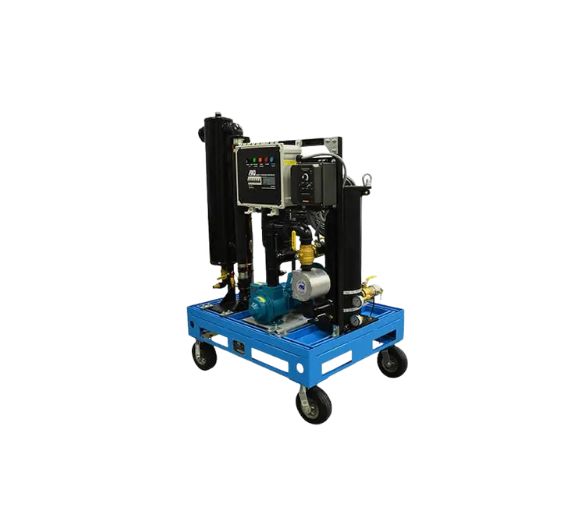
The MTC HC-90 high capacity mobile fuel polishing system is a skid-mounted, industrial-grade unit engineered to eliminate water, sludge, and particulate contamination from large diesel and bio-fuel storage tanks. Delivering a variable flow rate of 10–90 GPM (37.9–340.7 LPM) via an integrated VFD controller, the system drives fuel through a comprehensive multi-stage cleaning circuit comprising a bag filter vessel for primary bulk removal, an FP-90 mechanical water separator, an LG-X 4000 inline magnetic fuel conditioner, and a cartridge fine filter vessel accepting 2–30 micron particulate, 10–30 micron water block, or 3–10 micron micro-glass elements. Controlled by the SFC70 Smart Filtration Controller with integrated High Water, High Vacuum, and High Pressure alarms, and operable by remote pendant, the MTC HC-90 is purpose-built for reliable, high-throughput fuel maintenance at demanding industrial sites.
The MTC HC-90 is a purpose-built high capacity fuel polishing system designed for operations that require fast, thorough cleaning of large diesel and bio-fuel storage tanks. Mounted on a portable skid for straightforward repositioning between tank locations, the system draws fuel through a four-stage cleaning circuit — a bag filter vessel and mechanical water separator for primary bulk decontamination, an inline magnetic fuel conditioner for hydrocarbon stabilisation, and a high-efficiency cartridge fine filter for final particulate and water removal — all managed by the SFC70 Smart Filtration Controller with built-in safety shutdown alarms. With a VFD-adjustable flow rate between 10 and 90 GPM, the MTC HC-90 can be dialled to match each phase of a polishing cycle, from slow initial extraction of free water to full-rate recirculation during Phase 2 bulk cleaning and precision fine filtration in Phase 3. Remote pendant operation, locking 2-inch cam and groove connections, and multi-voltage power compatibility make it an adaptable, field-ready solution for marine, industrial, and standby power fuel maintenance programmes.
Specifications listed below apply to the standard MTC HC-90 high capacity mobile fuel polishing system. Replacement filter bags and cartridge filter elements are available separately — contact us with your requirements for part numbers and availability.
| Parameter | Specification |
|---|---|
| Nominal Flow Rate | 10–90 GPM (37.9–340.7 LPM) |
| Pump Type | 3 HP Sliding Vane Pump |
| Flow Control | Variable Frequency Drive (VFD) — 10 Hz to 60 Hz |
| Primary Filter | Bag Filter Vessel with Liner Basket (1–800µ Filter Bags) |
| Water Separator | FP-90 Mechanical Water Separator |
| Secondary Filter Options | Cartridge Filter Vessel — 2–30µ Particulate, 10–30µ Water Block, or 3–10µ Micro-glass Filters |
| Fuel Conditioner | LG-X 4000 Inline Magnetic Conditioner |
| System Controller | SFC70 Smart Filtration Controller with Safety and Alarm Features |
| Operating Modes | Manual, Remote (Pendant), Bypass, Fine Filtration |
| Safety Alarms | High Water, High Vacuum (16" HG), High Pressure (22 PSI) |
| Power Supply | 208-230V/60Hz/1Ph, 230V/50Hz/1Ph, 240V/60Hz/3Ph, or 480V/60Hz/3Ph |
| Plumbing Material | Black Iron |
| Inlet Port | 2" Cam & Groove |
| Outlet Port | 2" Cam & Groove |
| Suction Hose | Clear, 25 ft (7.6 m), 2" Diameter |
| Discharge Hose | 25 ft (7.6 m), 2" Diameter |
| Suction Capability (Primed) | 15 ft (4.6 m) vertical lift or 100 ft (30.5 m) horizontal run (2" line, primed) |
| Maximum Fluid Viscosity | 5 cSt |
| Operating Temperature Range | 41–104°F (5–40°C) |
| Dimensions (H × W × D) | ≈ 59" × 36" × 45" (150 × 91 × 114 cm) |
| Weight | ≈ 710 lbs (322 kg) |
| Compatible Fuels | Diesel and Bio-Fuel Blends (flash point ≥ 100°F / 37.8°C) |
Setting up the MTC HC-90 begins with connecting the system to a compatible power supply — single-phase or three-phase depending on site availability — and confirming the entire suction circuit, including the 2-inch clear suction hose, primary bag filter vessel, water separator, internal plumbing, and pump, is fully primed with diesel fuel. The pump is not self-priming and must never be started dry, as running without fuel will cause rapid pump damage. Once primed, the suction hose is positioned so its tip reaches the lowest accessible point of the fuel storage tank, targeting the area where water and sludge naturally accumulate. Both hoses connect to the system via locking 2-inch cam and groove couplings for secure, tool-free connection at each tank service location.
A three-phase polishing approach is recommended for tanks carrying meaningful contamination. In Phase 1, the system operates in bypass mode at a reduced VFD speed of 10–20 Hz, with the discharge hose directed to a separate waste container. Running at low speed prevents free water and settled sludge from being agitated into an emulsified state as they are drawn from the tank bottom; the operator monitors the clear suction hose for visible flow quality and inspects the discharge container periodically to confirm that bulk water and sludge are being removed. Once the discharge transitions to primarily fuel, the Water Separator is drained via its drain valve, and Phase 2 begins by returning the discharge hose to the fuel tank and raising VFD speed to increase throughput. Fuel now recirculates through the primary bag filter and FP-90 water separator, with progressive reduction in bag filter micron rating removing residual large particulate. The High Vacuum alarm threshold of 16 inches HG on the SFC70 controller signals when the primary bag filter bag requires replacement during this phase.
Phase 3 transitions the MTC HC-90 to fine filtration mode by switching the discharge hose connection to the secondary outlet port, routing polished fuel through the cartridge fine filter vessel after the primary filtration stages. Pressure gauges on the secondary filter vessel provide real-time element loading indication — when pressure approaches 22 PSI, the High Pressure alarm activates and shuts the pump down to indicate that the cartridge element requires replacement before polishing continues. Throughout all phases, the SFC70 Smart Filtration Controller continuously monitors all three alarm channels and executes automatic pump shutdown if any alarm threshold is exceeded, protecting the system from unattended damage and ensuring that each phase of the polishing cycle is completed within safe operating parameters. When polishing is complete, the system is drained and stored using the controlled drain and purge procedure before the next deployment.
The MTC HC-90 is designed for use with diesel fuel and bio-diesel blends with a flash point at or above 100°F (37.8°C). It must not be used with gasoline, petrol, or any other flammable liquid below this flash point threshold — operating with such fluids presents an immediate fire and explosion hazard. Always confirm the flash point of the fuel before connecting and starting the system, particularly when working with unfamiliar bio-blend formulations or fuel drawn from mixed-use storage tanks.
Flow rate on the MTC HC-90 is controlled by the onboard Variable Frequency Drive (VFD) using a frequency knob that adjusts output between 10 Hz and 60 Hz. The relationship between frequency and flow rate follows the formula: Flow Rate (GPM) = 2/3 × Frequency (Hz). At 60 Hz on a 230 or 480 VAC/60 Hz supply, the system delivers 90 GPM. At 10 Hz, the minimum rate is approximately 6.7 GPM. Operators typically run Phase 1 sludge extraction at 10–20 Hz to avoid disturbing settled contamination, then increase speed progressively for Phase 2 recirculation and Phase 3 fine filtration as tank conditions improve.
The SFC70 monitors three independent alarm channels. The High Water alarm triggers when the Water Detection Sensor Probe on the FP-90 mechanical water separator detects excessive water accumulation, automatically shutting the pump down to prevent water-laden fuel from reaching the secondary fine filter. The High Vacuum alarm activates at 16 inches HG on the suction side, signalling that the primary bag filter element is clogged and needs replacement. The High Pressure alarm fires at 22 PSI on the discharge side when the secondary cartridge filter element has reached its service limit. Each alarm halts the pump automatically, and a full restart requires the fault to be corrected and the Alarm Reset button to be pressed at the system controller.
On tanks carrying heavy free water, sludge, or coarse particulate loads, routing fuel immediately through the precision cartridge fine filter would cause rapid element saturation well before meaningful tank cleaning has been achieved — generating unnecessary filter element cost and multiple operational pauses for cartridge replacement before the fuel is genuinely clean. Bypass mode routes fuel exclusively through the lower-cost primary bag filter and FP-90 water separator during Phases 1 and 2, reducing contamination burden to a level where the secondary cartridge filter can be engaged for final polishing in Phase 3 without premature loading. This phased approach significantly lowers per-tank maintenance cost and maximises cartridge element service life, particularly on large or heavily fouled tanks.
The MTC HC-90 is available in four electrical configurations: 208-230V/60Hz single-phase, 230V/50Hz single-phase, 240V/60Hz three-phase, and 480V/60Hz three-phase. This multi-voltage flexibility allows the system to be deployed across a wide range of industrial sites internationally, from single-phase workshop supplies to three-phase industrial distribution boards. The system must be connected to the supply voltage matching its nameplate rating, must be properly grounded before operation, and should only be operated and maintained by qualified personnel familiar with the equipment and its operating manual.
The LG-X 4000 is a passive inline magnetic conditioner permanently installed in the MTC HC-90's fuel circuit. As fuel passes through the conditioner's magnetic field, the charge distribution of hydrocarbon molecules and ferrous micro-particles is altered, reducing their tendency to aggregate into larger sludge formations and improving fuel homogeneity for downstream combustion. The conditioner also assists in breaking up existing micro-particle clusters before the secondary fine filter stage, potentially extending cartridge element life by reducing the compacted particulate load entering the filter housing. As a no-maintenance, no-power passive device, it provides continuous fuel conditioning benefits throughout every polishing cycle at no additional operating cost.
Our engineers will confirm the correct filter configuration, replacement bag and cartridge part numbers, and system accessories for your high capacity fuel polishing application — and provide full technical documentation and a competitive quote tailored to your tank size, fuel type, flow rate requirement, and operational environment.
.png)
.png)
.png)
.png)
.png)
.png)
.png)