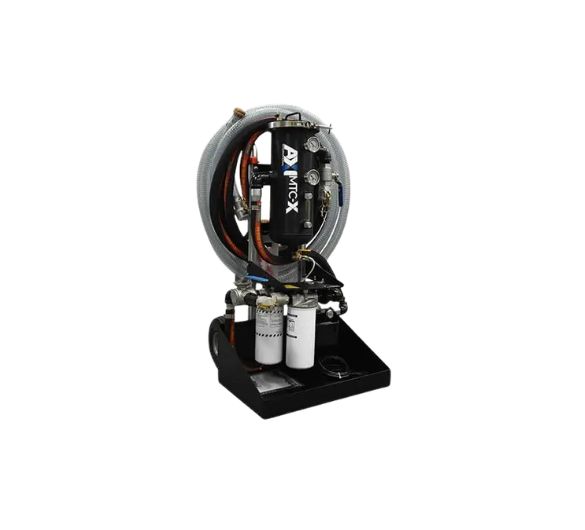
The MTC-X mobile fuel polishing system is a cart-based, AC-powered industrial unit engineered to eliminate water, sludge, and particulate contamination from diesel and bio-fuel storage tanks wherever they are located. Delivering a nominal flow rate of 26 GPM / 1,560 GPH, the system processes fuel through a staged cleaning circuit comprising a bag filter vessel accepting 1–800 micron filter bags for primary bulk removal, followed by dual spin-on fine filters selectable from 3, 10, or 25 microns — including water block variants. Its wheeled cart design, locking 1.5-inch cam and groove connections, 25-foot hoses, manual additive injection capability, and integrated spill containment tray make it a self-contained polishing unit built for demanding, real-world fuel maintenance work across multiple tank locations.
The MTC-X is a purpose-built mobile fuel polishing system designed for maintenance teams that need to service diesel and bio-fuel storage tanks at multiple locations without fixed infrastructure. Powered from a standard AC mains outlet and mounted on a wheeled cart for unrestricted site mobility, the system draws fuel through a two-stage cleaning circuit — a high-capacity bag filter vessel for bulk water and sludge removal at the primary stage, followed by dual spin-on fine filters for precision particulate and water separation downstream. With a 26 GPM / 1,560 GPH flow rate, the MTC-X can process over 12,400 gallons in a standard eight-hour maintenance window. Its fine filter bypass mode, manual additive injection, filter drain and purge capability, locking cam and groove connections, and built-in spill containment tray are all engineered for efficient, safe, and cost-effective fuel maintenance work in marine, industrial, and standby power environments.
Specifications listed below apply to the standard MTC-X mobile fuel polishing system. Replacement filter bags and spin-on filter elements are available separately — contact us with your requirements for part numbers and availability.
| Parameter | Specification |
|---|---|
| Nominal Flow Rate | 26 GPM / 1,560 GPH (98.4 LPM / 5,905 LPH) |
| Processing Capacity (8-hour shift) | 12,480 gallons (47,242 litres) |
| Processing Capacity (24-hour period) | 37,440 gallons (141,726 litres) |
| Pump Type | 3/4 HP Rotary Vane Pump |
| Power Supply | 120V/60Hz/15A or 230V/50Hz/15A* |
| Primary Filter | Bag Filter Vessel with Liner Basket (1–800µ Filter Bags) |
| Secondary Filter Options | 3, 10, or 25µ Fine Filter or 3, 10µ Water Block |
| Secondary Filter (Standard Issue) | 10µ Fine Filter (Part No. FF-10) |
| Number of Fine Filter Housings | 2 (Dual Spin-On Fine Filters) |
| Plumbing Material | Black Iron |
| Inlet Port | 1.5" Cam & Groove |
| Outlet Port | 1.25" Cam & Groove |
| Suction Hose | Clear, 25 ft (7.6 m), 1.5" Diameter |
| Discharge Hose | 25 ft (7.6 m), 1.25" Diameter |
| Suction Capability (Primed) | 15 ft (4.6 m) vertical lift or 100 ft (30.5 m) horizontal run (lines >1.5", primed) |
| Operating Temperature Range | 41–104°F (5–40°C) |
| Dimensions (H × W × D) | ≈ 48" × 22.5" × 25" (122 × 57 × 63 cm) |
| Weight | ≈ 185 lbs (84 kg) |
| Compatible Fuels | Diesel and Bio-Fuel Blends (flash point ≥ 100°F / 37.8°C) |
| Fine Filter Change Indicator | 20–25 PSI / red zone on individual pressure gauges |
| Special Functions | Manual Additive Injection, Fine Filter Bypass, Filter Drain/Purge |
*At 50 Hz, nominal flow rate decreases from 26 GPM / 1,560 GPH to 20.8 GPM / 1,248 GPH.
Setting up the MTC-X begins with connecting the system to a grounded AC mains supply — either 120V/60Hz or 230V/50Hz — and attaching both hoses using the locking cam and groove couplings. The 1.5-inch clear suction hose connects to the inlet port and is positioned so its tip reaches the lowest accessible point of the fuel storage tank, targeting the area where water and sludge naturally settle. The 1.25-inch discharge hose is connected to the outlet port. Before starting the pump, the entire suction circuit — including the hose, primary bag filter vessel, internal plumbing, and pump — must be fully primed with fuel. The pump does not self-prime and must never be started without fuel in the circuit, as dry running will cause pump damage.
For tanks carrying significant contamination, a three-phase polishing approach is recommended. In Phase 1, the system operates in bypass mode with the discharge hose directed into a separate waste container, allowing bulk free water and bottom sludge to be drawn from the tank and discarded without recirculating contamination. The water level sight glass on the primary bag filter vessel provides continuous visual indication of accumulated water, and the filter drain valve is used to discharge water as needed during this phase. When vacuum gauge differential between the two primary filter gauges reaches 15 inches HG, the filter bag should be replaced. In Phase 2, still in bypass mode, the discharge hose is returned to the tank and fuel is recirculated while progressively reducing the primary bag filter micron rating, systematically removing residual large particulate before the fine filters are engaged.
Phase 3 transitions the MTC-X to fine filtration mode by moving the diverter ball valve to the second position, routing fuel through the dual spin-on fine filters after the primary bag filter. Pressure gauges on each fine filter housing monitor element loading in real time — when either gauge enters the red zone or the combined system pressure approaches 20–25 PSI, the corresponding filter element must be replaced. Once polishing is complete and clean fuel samples confirm acceptable tank condition, the fine filter purge procedure is performed using the accessory selector's VAC position to recover residual fuel from the filter housings before element changes, and the system is drained for storage. If fuel treatment additives are required, the accessory selector's INJ position enables in-line additive introduction during any active polishing phase without interrupting operation.
The MTC-X is designed for use with diesel fuel and bio-diesel blends that have a flash point at or above 100°F (37.8°C). It must not be used with gasoline, petrol, or any other flammable liquid below this flash point threshold — operating the system with such fluids creates an immediate fire and explosion hazard. Always confirm the flash point of the fuel before connecting and running the system, particularly when working with unfamiliar bio-blend formulations or fuel drawn from mixed-use storage tanks.
The MTC-X operates at a nominal flow rate of 26 GPM (1,560 GPH / 98.4 LPM). This equates to approximately 12,480 gallons (47,242 litres) in an 8-hour maintenance shift and up to 37,440 gallons (141,726 litres) over a 24-hour continuous run. When running on a 50 Hz mains supply, the flow rate reduces to 20.8 GPM / 1,248 GPH.
Fine filter cartridges (available in 3µ, 10µ, and 25µ absolute ratings) remove particulate contamination down to their rated micron size and are the correct choice when particulate is the primary concern. Water block filters (3µ WB-3 and 10µ WB-10) provide the same particulate removal performance but additionally incorporate hydrophobic filter media that actively prevents both free and emulsified water from passing downstream. For tanks with combined water and particulate contamination, best practice is to complete Phase 1 and Phase 2 bulk cleaning with a coarser bag filter first, then engage the water block fine filter cartridge in Phase 3 to achieve the highest attainable fuel cleanliness standard.
Engaging the fine filters immediately on a heavily fouled tank would cause them to load rapidly with bulk contamination well before meaningful tank cleaning has been achieved, dramatically increasing the number of elements consumed and the overall cost of the polishing session. Bypass mode routes fuel exclusively through the primary bag filter, removing bulk free water, heavy sludge, and coarse particulate at lower cost per element before the spin-on fine filters are introduced for Phase 3 precision polishing. This staged approach protects the fine filter investment, reduces per-tank maintenance cost, and ensures that the absolute-rated final filtration stage is only applied once the fuel has already been substantially cleaned by the primary stage.
The MTC-X includes a built-in additive injection system controlled by the accessory selector switch located below the primary filter vessel. With the pump running, placing the flexible accessory hose into an additive container and rotating the selector to the INJ position creates a vacuum that draws the additive into the fuel circuit, distributing it throughout the tank volume as polishing continues. Injection rate is controlled by partially closing the inlet ball valve to increase available vacuum. Once the required dose has been injected, the selector is returned to the OFF position to resume standard polishing. This function is useful for introducing biocides, fuel stabilisers, or combustion improvers during routine maintenance visits without requiring separate application equipment.
The MTC-X features two individual pressure gauges — one for each fine filter housing — plus an overall system pressure gauge. As a spin-on element accumulates contamination and begins restricting fuel flow, its corresponding pressure gauge reading rises progressively. When either individual gauge needle enters the red zone, the corresponding filter element has reached its service limit and should be replaced before continuing the polishing session. If the combined overall system pressure reaches 20–25 PSI, both fine filter elements should be serviced immediately to protect the pump. A freshly installed element that immediately shows high pressure indicates a discharge-side restriction — such as a closed ball valve or blocked discharge line — which should be investigated before resuming operation.
Our engineers will confirm the correct filter configuration, replacement bag and cartridge part numbers, and system accessories for your fuel polishing application — and provide full technical documentation and a competitive quote tailored to your tank size, fuel type, and operational requirements.
.png)
.png)
.png)
.png)
.png)
.png)
.png)