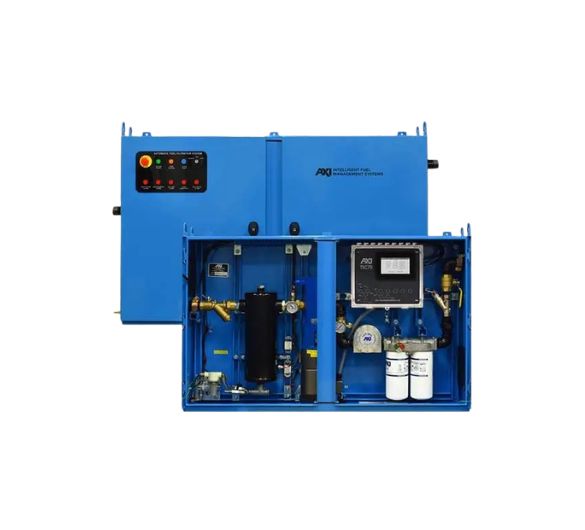
The STS 6020 and 7020 are programmable, fully automated fuel maintenance systems that remove water, sludge, and other contaminants from diesel storage tanks. With a 20 GPM flow rate, the system polishes up to 9,600 gallons in an eight‑hour run cycle. The NEMA‑rated enclosure supports both outdoor and indoor installations, making it a reliable choice for generator sets, marine vessels, and bulk fuel storage facilities.
The STS 6020 | 7020 is an automated diesel fuel polishing system designed to maintain stored fuel quality by continuously removing water, particulate matter, and microbial contamination. The system operates independently once installed, using a programmable timer to run routine filtration cycles without operator intervention. Suitable for diesel and biodiesel blends, the unit stabilizes fuel, prevents sludge buildup, and protects downstream engines. The enclosure meets NEMA 3R, 4, or 4X ratings, allowing installation in harsh weather or corrosive environments. Common applications include backup generator fuel tanks, marine fuel storage, and industrial bulk diesel reservoirs.
The STS 6020 and 7020 systems combine robust mechanical components with intelligent controls to deliver reliable, unattended diesel fuel maintenance. Each feature is engineered to reduce downtime and protect critical assets.
Detailed performance, electrical, and dimensional data for the STS 6020 and 7020 fuel maintenance systems. All values are nominal unless otherwise noted.
| Parameter | Specification |
|---|---|
| Nominal Flow Rate | 20 GPM / 1,200 GPH (75.7 LPM / 4,542 LPH) At 50 Hz: 16 GPM / 960 GPH |
| Primary Filtration | Mechanical Water Separator with water detection probe |
| Secondary Filtration | Two spin‑on cartridges: 3, 10, or 25 micron fine filter or water‑block element |
| Fuel Conditioner | LG‑X 4000 Inline Magnetic Conditioner |
| Pump Type | 1.5 HP Spur Gear Pump, Viton seals, continuous duty |
| System Controller (6020) | SFC70 Smart Filtration Controller with PLC‑based timer and alarms |
| System Controller (7020) | TSC70 Touchscreen Controller with data logging and Modbus TCP/IP |
| Electrical Requirements | 120V/60Hz/1Ph or 230V/50Hz/1Ph |
| Inlet / Outlet Ports | 1.5″ NPT female |
| Wetted Materials | Black iron plumbing, Viton seals, aluminum housing for pump |
| System Enclosure Rating | NEMA 3R (standard), NEMA 4 or NEMA 4X stainless steel (optional) |
| Controller Enclosure Rating | NEMA 4 and UL508a listed |
| Dimensions (H × W × D) | ≈ 37″ × 60″ × 12″ (94 × 152 × 31 cm) |
| Shipping Weight | ≈ 620 lbs (281 kg) |
| Maximum Fluid Viscosity | 5 cSt |
| Suction Capability (primed) | 15 ft vertical lift or 100 ft horizontal run (1.5″ line) |
| Operating Temperature (6020) | 41 – 104°F (5 – 40°C) |
| Operating Temperature (7020) | 41 – 122°F (5 – 50°C) |
| Safety Certification | Not for use with fluids having flash point below 100°F (37.8°C) |
The STS 6020/7020 fuel maintenance system operates as a kidney loop that continuously recirculates and polishes diesel fuel from the storage tank. During a programmed runtime, the spur gear pump draws fuel from the lowest point of the tank through a wye strainer, which captures large debris. The fuel then enters a mechanical water separator where free water is removed and collected in a sump with a water detection sensor. Next, the fuel passes through two fine filter cartridges that remove particles down to 3 microns. An inline magnetic conditioner alters the molecular structure of the fuel to prevent soft sludge formation. Clean, conditioned fuel is returned to the tank through a separate port, ideally placed away from the suction point to ensure thorough mixing. The system monitors vacuum on the suction side and pressure on the discharge side; if filters become clogged or water accumulates, the controller triggers an alarm and shuts down the pump to prevent damage. A flow switch confirms adequate circulation, and a leak detection float in the drip tray immediately stops the pump if any leakage occurs.
The STS 6020 uses an SFC70 Smart Filtration Controller with an LCD display and physical buttons for programming. The STS 7020 features a TSC70 touchscreen interface that supports data logging, Modbus TCP/IP communication, and more advanced configuration options. The 7020 also has a slightly wider operating temperature range (up to 122°F vs 104°F).
The system uses a mechanical water separator (primary) and two spin‑on fine filters (secondary). Fine filters are available in 3, 10, or 25 micron absolute ratings, as well as water‑block versions. Under normal conditions, filter elements should be replaced at least every six months or whenever a high‑pressure or high‑vacuum alarm occurs.
Yes, the system is designed to stabilize diesel and bio‑diesel fuels. The inline magnetic conditioner helps reduce microbial contamination and soft sludge formation commonly associated with biodiesel. However, always verify compatibility with your specific blend and consult the manual for viscosity limitations (max 5 cSt).
The system includes alarms for high vacuum (clogged suction), high pressure (clogged fine filters), low/no flow, water detection in the separator, leak detection (drip tray float), pump thermal overload, and—when configured—tank overflow for multi‑tank setups. Each alarm triggers a pump shutdown and an indicator light.
Yes, the 7000 series controller supports Modbus TCP/IP communication via an Ethernet port. This allows remote monitoring of system status, alarm conditions, and runtime logs. The controller also provides dry contacts for summary alarm and leak detection for integration with external supervisory systems.
Standard units require manual draining of the water separator bowl via a yellow safety drain valve. An optional Auto Water Drain (AWD) accessory is available that automatically purges collected water when the high‑water sensor is triggered, reducing maintenance frequency.
Our engineers will help you select the correct STS model (6020 or 7020), enclosure type (NEMA 3R, 4, or 4X), filter micron rating, and optional accessories (auto water drain, multi‑tank polishing, additive injection, etc.) for your specific fuel storage and operational requirements. Whether you need a single unit for a backup generator or a fleet‑wide solution, we provide full technical documentation and a competitive quote tailored to your needs.
.png)
.png)
.png)
.png)
.png)
.png)
.png)