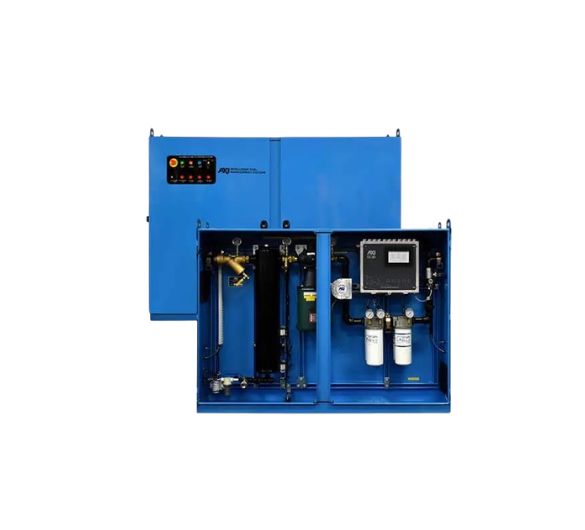
The STS 6040 and STS 7040 are programmable, fully automated fuel maintenance systems designed to remove water, sludge, and microbial contamination from diesel storage tanks. With a 40 GPM flow rate, these industrial fuel polishers ensure clean, reliable fuel for backup generators, marine vessels, and heavy-duty diesel engines. Available with PLC or touchscreen controls and NEMA-rated enclosures for indoor or outdoor installation.
The STS Series fuel polishing system continuously circulates diesel fuel from your storage tank through a multi-stage filtration process that separates free water, removes particulate down to 3 microns, and eliminates microbial growth. Once installed and programmed with your desired runtime schedule, the system operates autonomously — requiring no daily intervention. It is ideally suited for standby generator tanks, marine fuel storage, off-highway equipment, and any diesel-powered application where fuel quality directly impacts operational reliability and engine life.
The STS 6040 and STS 7040 combine robust mechanical components with intelligent electronic controls, delivering dependable diesel fuel conditioning across the most demanding industrial and commercial environments.
Key performance and dimensional data for the STS 6040 and STS 7040 fuel polishing systems.
| Parameter | Specification |
|---|---|
| Product Series | STS 6040 / STS 7040 |
| Nominal Flow Rate | 40 GPM / 2,400 GPH (151 LPM / 9,085 LPH) |
| 8-Hour Polishing Capacity | 19,200 gallons (72,680 liters) |
| Inlet Strainer | 20 mesh wye-strainer |
| Primary Filter | Mechanical water separator |
| Secondary Filter Options | 3µ, 10µ, or 25µ fine filter; 3µ or 10µ water-block filter |
| Fuel Conditioner | LG-X 4000 inline magnetic conditioner |
| Pump | 5 HP spur gear pump, Viton seals |
| System Controller (6040) | Smart Filtration Controller (SFC80) with PLC and LCD display |
| System Controller (7040) | Touchscreen controller (TSC80) with HMI |
| Power Options | 240V/60Hz/3Ph, 480V/50Hz/3Ph, 480V/60Hz/3Ph |
| Plumbing Material | Black iron |
| Port Sizes | 2" NPT inlet, 1.5" NPT outlet |
| Standard Enclosure | NEMA 3R, powder-coated steel |
| Upgrade Enclosures | NEMA 4, NEMA 4X stainless steel |
| Controller Enclosure Rating | NEMA 4, UL508A |
| Dimensions (H x W x D) | Approximately 56" x 72" x 17" (142 x 183 x 43 cm) |
| Weight | Approximately 1,005 lbs (455.9 kg) |
| Maximum Vacuum (Normal) | 15" Hg |
| Maximum Pressure (Normal) | 22 PSI |
| Pressure Relief Set Point | 48–50 PSI |
| Maximum Suction Lift | 15 ft (4.57 m) vertical |
| Maximum Horizontal Run | 100 ft (30.48 m) |
| Flash Point Restriction | Do not use with fluids below 100°F (37.8°C) flash point |
The fuel polishing process begins when the programmable controller activates the 5 HP gear pump according to your preset schedule. Fuel is drawn from the lowest point of the storage tank through a 20-mesh wye strainer, which captures large debris. From there, the fuel enters the mechanical water separator, where free water settles to the bottom and can be drained manually or automatically (with the optional Auto Water Drain system).
After leaving the water separator, the fuel passes through the primary fine filter — available in 3, 10, or 25 micron ratings — which removes suspended particulates and any remaining emulsified water (when a water-block element is used). An optional LG-X 4000 inline magnetic conditioner treats the fuel before it returns to the storage tank through the outlet port, ideally positioned away from the pickup point to promote complete tank circulation. Throughout the cycle, pressure and vacuum sensors, a flow switch, and a water detection probe continuously monitor system health. If any reading exceeds its set point — such as high vacuum indicating a clogged filter — the controller immediately shuts down the pump and alerts the operator, preventing damage and identifying required maintenance.
Both systems share the same 40 GPM flow rate, 5 HP pump, and filtration components. The STS 6040 uses a Smart Filtration Controller with a PLC and LCD display, while the STS 7040 features a full-color touchscreen HMI controller. The 7040 also supports Modbus TCP/IP communication for integration with external monitoring systems and building management networks.
The system operates at a nominal flow rate of 40 gallons per minute (GPM), which is equivalent to 2,400 gallons per hour (GPH) or approximately 9,085 liters per hour (LPH). In an 8-hour runtime, the system can polish up to 19,200 gallons (72,680 liters) of diesel fuel.
Yes. The standard enclosure is rated NEMA 3R, providing protection against falling rain, sleet, snow, and external ice formation. For more demanding environments, optional NEMA 4 and NEMA 4X stainless steel enclosures offer additional protection against windblown dust, hose-directed water, and corrosive conditions.
When a water detection sensor in the separator bowl triggers, the system pauses the filtration cycle, opens a solenoid drain valve, and activates an accessory pump to transfer the collected water into a separate collection drum. Once the water level drops below the low sensor, normal operation resumes automatically.
The system monitors high vacuum (clogged primary filter), high pressure (clogged secondary filter), no flow or low flow, water in the separator bowl, pump overload, and leak detection via a float switch in the drip tray. When any alarm condition occurs, the pump shuts down and an alert is displayed on the controller.
Yes. The STS 7040 touchscreen controller supports Modbus TCP/IP communication via its Ethernet port, allowing remote monitoring and control. Additionally, the controller provides dry alarm contacts for summary alarm and leak detection, which can be wired into external building management or SCADA systems.
Our engineers will confirm the correct STS 6040 or STS 7040 configuration for your specific tank size, fuel type, and application. Whether you need a NEMA 4X enclosure for marine use or Modbus integration for remote monitoring, we provide full technical documentation and a competitive quote tailored to your requirements and operating environment.
.png)
.png)
.png)
.png)
.png)
.png)
.png)