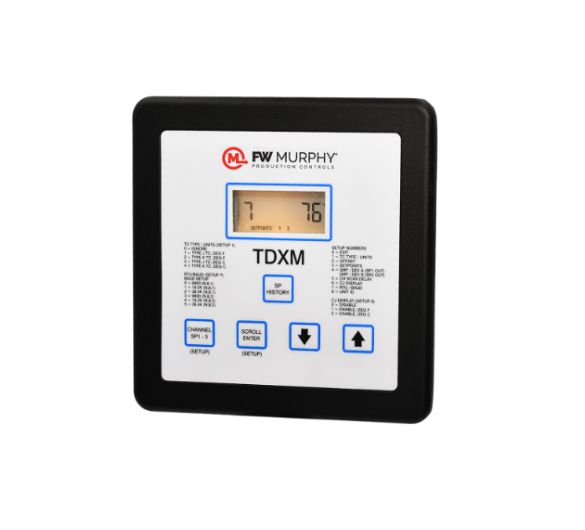
The TDXM-DC Temperature Scanner / Pyrometer is a configurable, multi-channel thermocouple monitoring instrument designed for demanding industrial, marine, and oil & gas applications. Supporting up to 24 Type J or K thermocouple inputs, it provides real-time temperature scanning, programmable set point alarms, group deviation monitoring, and built-in RS485 Modbus RTU communication—all powered from a wide-range 10–32 VDC supply.
Precision thermocouple scanning with multi-channel configurability, industrial-grade communication, and third-party hazardous area certification for reliable performance in critical monitoring applications.
| Parameter | Specification |
|---|---|
| Power Input | 10–32 VDC, 4.2 W maximum |
| Thermocouple Inputs | Up to 24 channels; Type J or K, grounded or ungrounded (ungrounded recommended) |
| Set Points per Channel | 3 adjustable set points (SP1, SP2, SP3) per channel |
| Outputs | Two (2) FET outputs: 0.5 A, 350 VDC, sink-to-ground on trip; One (1) Form-C Solid State Relay: 0.125 A, 350 VDC / 240 VAC (de-energized on trip) |
| Communications | RS485 Serial Port, Modbus RTU Server; configurable baud rate, stop bits, and node number |
| Sensor Scan Rate | All 24 channels scanned within 2 seconds |
| Measurement Range – Type K | 0°F to 1999°F (0°C to 1093°C) |
| Measurement Range – Type J | 0°F to 1538°F (0°C to 837°C) |
| Accuracy – Cold Junction | Better than ±1.0°F (±0.5°C) |
| Accuracy – Type J or K | ±2°F (±1°C) over 100°F–1999°F (38°C–1093°C) |
| Cold Junction Compensation | -40°F to 185°F (-40°C to 85°C) |
| Display | 7-segment, 7-character backlit LCD; 1/2 in (13 mm) character height; shows temperature, units, and set point trip indication |
| Operating / Storage Temperature | -40°F to 185°F (-40°C to 85°C) |
| Open Thermocouple Detection | Drives channel reading high on open sensor condition |
| Set Point History | Last trip per output stored in non-volatile memory |
| Group Deviation Monitoring | Up to 2 temperature groups; alarms or shuts down on deviation from group average |
| Third-Party Approvals | CSA Class I, Division 2, Groups C and D |
| Dimensions (H × W × D) | 5.2 in × 6.8 in × 2.2 in (133.3 mm × 172.9 mm × 55.9 mm) |
| Shipping Weight | Approx. 2 lb (0.93 kg) |
| Shipping Dimensions | 5.5 × 9 × 9.5 in (140 × 229 × 241 mm) |
| Optional Accessories | RS485 to USB interface kit with 10-inch cable (Part No. 53702325); MConfig™ configuration software (free download) |
The TDXM-DC continuously scans all configured thermocouple channels in a two-second cycle, reading live temperature data from up to 24 Type J or K sensors connected via screw-terminal pairs. Each channel is evaluated independently against its three programmed set points — SP1, SP2, and SP3 — which map directly to the unit's three output circuits. When a channel's temperature crosses a set point threshold, the corresponding FET or Form-C relay output activates within the same scan cycle, triggering downstream alarms, shutdown circuits, or control actions.
The Group Deviation (GRP/DEV) function adds a layer of comparative intelligence: the instrument calculates a running average across designated channel groups — such as all exhaust cylinders or all bearing sensors — and flags any individual reading that strays beyond the configured deviation limit. This approach catches gradual performance degradation that fixed-threshold monitoring alone might miss.
All configuration — including thermocouple type selection, set point values, baud rate, and RTU node address — is performed through the front-panel five-button membrane keypad using a guided menu system. For larger deployments or fleet-wide configuration, the optional MConfig™ software and RS485-to-USB kit allow programming and data retrieval from a connected PC, while the Modbus RTU server enables ongoing data integration with SCADA and PLC platforms in real time.
The TDXM-DC supports up to 24 Type J or K thermocouple channels, each individually configurable for temperature unit, set point values, and alarm behavior. Unused channels can be set to Ignore so they do not appear in the display or generate any fault trip conditions.
The TDXM-DC is equipped with a built-in RS485 serial port configured as a Modbus RTU server. This allows it to communicate directly with PLCs, SCADA systems, DCS platforms, and industrial computers. The baud rate, stop bits, and RTU node number are all configurable from the front-panel keypad.
Yes. The TDXM-DC carries CSA Class I, Division 2, Groups C and D certification. This qualifies it for use in environments where flammable gases or vapors may be present under abnormal conditions, including oil & gas production, compressor stations, and petrochemical facilities. For outdoor installations, it should be mounted in a suitable weatherproof enclosure.
The Group Deviation (GRP/DEV) function monitors up to two groups of temperature channels and triggers an alarm or shutdown if any individual channel deviates beyond a set range from the group's running average. This is particularly useful for engine exhaust temperature balancing and bearing condition monitoring, where a rising deviation — rather than an absolute threshold — is the first sign of developing trouble.
Ungrounded thermocouples are recommended for use with the TDXM-DC. When grounded thermocouples are used, differences in grounding potential between devices can introduce reading errors. Using ungrounded sensors eliminates this source of interference and ensures the highest measurement accuracy across all 24 channels.
Yes. The optional RS485-to-USB interface kit (Part No. 53702325) connects the TDXM-DC to a Windows PC, and the free MConfig™ configuration software allows engineers to configure all parameters, review set point history, and manage channel assignments from a computer — streamlining setup for complex or multi-unit deployments.
Our engineers will recommend the right display for your specific application, send you the full technical datasheet, and provide a competitive quote.
.png)
.png)
.png)
.png)
.png)
.png)
.png)
.png)