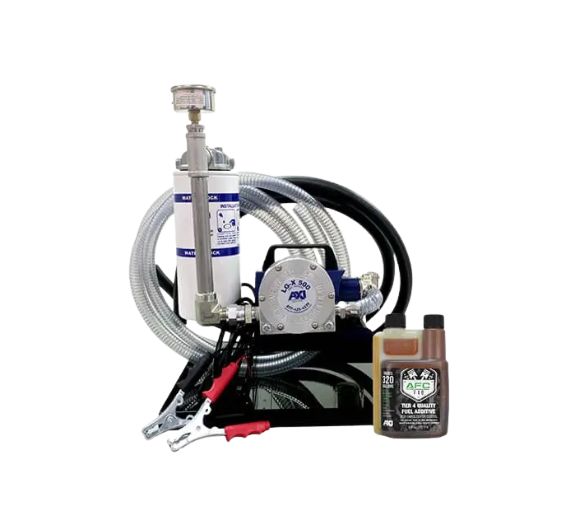
TK-240 XT mobile fuel polishing system — compact 12V portable unit with helical spur gear pump, 50-mesh T-strainer, LG-X 500 inline magnetic conditioner, dual-stage fine filter, pressure gauge, and spill containment tray for diesel and bio-fuel tank cleaning
Fuel Polishing System
240 GPH Flow | 12V DC Powered | Dual-Stage Filtration
Fuel Management Systems · Fuel Polishing · Diesel Tank Cleaning

TK-240 XT Mobile Fuel Polishing System – Portable 240 GPH Diesel and Bio-Fuel Tank Cleaner with Dual-Stage Filtration and Magnetic Conditioning

The TK-240 XT mobile fuel polishing system is a compact, 12V DC-powered portable unit engineered to remove water, sludge, microbial contamination, and particulate matter from diesel and bio-fuel storage tanks. Delivering a nominal flow rate of 4 GPM / 240 GPH, it processes fuel through a staged cleaning circuit that includes a 50-mesh T-strainer, an LG-X 500 inline magnetic conditioner, and a secondary spin-on fine filter rated to either 10 microns or 3 microns with water-blocking capability. Weighing approximately 26 lbs and built on an integrated spill containment tray, the TK-240 XT is designed for portability and ease of use in locations where tank access is limited — including marine vessels, generator rooms, remote fuel stores, and industrial facilities.

240 GPH Flow Rate
12V / 10A Power Supply
3µ / 10µ Filtration Rating
26 lbs Unit Weight

The TK-240 XT is a purpose-built mobile fuel polishing system that addresses one of the most common causes of diesel engine failure — degraded fuel quality in storage tanks. Using a 12V-powered helical spur gear pump, the system draws fuel from the tank bottom, passes it through a coarse strainer to capture large debris, then through an inline magnetic conditioner that targets ferrous particles and sludge precursors, and finally through a high-efficiency secondary spin-on filter that removes sub-10-micron particulate or actively blocks both particulate and free water depending on the selected cartridge. The result is fuel that meets the cleanliness standards required for reliable injection system and engine performance. Its compact footprint, integrated carrying handle, and spill containment tray make it equally practical on a marine fuel tank, a standby generator day-tank, or a remote bulk storage container.

  • Helical Spur Gear Pump for Consistent, Self-Sustaining Fuel Transfer: The TK-240 XT is driven by a nickel-plated brass helical spur gear pump rated at 4 GPM / 240 GPH, delivering steady and reliable fuel movement without the pressure fluctuations associated with diaphragm or centrifugal pump designs. The helical gear profile provides quieter operation and smoother flow at the system's working pressure, making it well suited to the recirculation duty cycles typical of fuel polishing work. Once primed, the pump maintains flow through the full cleaning circuit with minimal operator attention. Operating from a standard 12V / 10A DC source, it can be powered directly from a vehicle battery, vessel power bus, or portable battery pack, giving the system genuine field-deployable flexibility without dependence on mains power.
  • Two-Stage Filtration for Complete Particulate and Water Removal: Fuel passes through two distinct filtration stages before returning to the storage tank. The primary 50-mesh T-strainer captures coarse debris — rust flakes, scale, sediment, and biological matter — preventing it from loading or damaging the secondary filter prematurely. Downstream, the secondary spin-on fine filter provides precision cleaning at either 10 microns for heavy particulate contamination or 3 microns with water-blocking capability for combined particulate and free-water removal. For tanks with severe contamination, the recommended practice is to begin polishing passes using the 10µ cartridge and complete the final passes with the 3µ water block filter, progressively improving fuel cleanliness until it achieves a visually clear and bright appearance. Replacement filter cartridges (FFS-10 and WBS-3) are readily available for in-field servicing.
  • LG-X 500 Inline Magnetic Fuel Conditioner for Enhanced Fuel Stability: Between the primary strainer and the secondary fine filter, fuel passes through the LG-X 500 inline magnetic conditioner — a component that uses a focused magnetic field to attract and cluster ferrous particulate matter, helping to prevent the fine metallic contamination that evades mechanical filtration from reaching the secondary filter or recirculating into the tank. Magnetic conditioning also assists in disrupting the molecular clustering behaviour associated with fuel aging and bio-diesel blends, helping to maintain the combustibility and stability of the fuel through repeated polishing cycles. The inline installation of the conditioner adds no restriction to the flow path and requires no maintenance beyond the standard periodic system inspection.
  • Ultra-Portable Design for Small Tanks and Restricted Access Locations: At approximately 26 lbs (11.8 kg) and packaged within a 13 × 12 × 12 inch footprint, the TK-240 XT is genuinely hand-portable and can be transported to and deployed at tank locations where permanent or skid-mounted polishing equipment cannot be practically installed. The integrated carrying handle allows single-person deployment, and the 15 ft (4.6 m) suction and discharge hoses provide sufficient reach to service tanks in recessed bilge spaces, under-floor voids, and generator enclosures. The built-in spill containment tray captures any incidental fuel drips during connection, disconnection, and filter service, reducing the risk of environmental contamination and maintaining a clean working area throughout the polishing operation.
  • Integrated Pressure Gauge for Real-Time Filter Condition Monitoring: A pressure gauge mounted between the gear pump outlet and the secondary filter housing provides the operator with continuous visibility of system operating pressure throughout each polishing session. As the secondary filter element accumulates contamination, flow restriction increases and the gauge reading rises progressively. A reading of 15 PSI, or needle movement into the red zone on the gauge dial, provides a clear, unambiguous signal that the filter element has reached its capacity and should be replaced before the next polishing run. This built-in monitoring removes guesswork from filter service intervals and ensures the system consistently delivers its rated 10µ or 3µ filtration performance across the full working life of each filter cartridge.
  • Compatible with Diesel and Bio-Fuel Blends for Modern Fuel Applications: The TK-240 XT is rated for operation with both conventional diesel fuel and bio-fuel blends commonly used in marine propulsion, standby power generation, and on-highway and off-highway equipment. Bio-diesel blends are particularly susceptible to water ingress, microbial growth, and fuel degradation in long-term storage — the combination of dual-stage filtration and magnetic conditioning in the TK-240 XT directly targets these failure modes. Note that the system must not be used with gasoline, petrol, or any fluid with a flash point below 100°F (37.8°C), as these present an immediate fire and explosion hazard at operating temperatures.
  • Marine Vessel Fuel Tanks — Sailing Yachts, Workboats, and Commercial Vessels: Diesel fuel stored in marine vessel tanks is exposed to the persistent moisture, temperature cycling, and motion that accelerate water ingress, microbial growth, and sludge formation — conditions that can result in filter clogging and engine failure at sea. The TK-240 XT can be used aboard vessels to polish fuel directly in the onboard tank, connecting via the inspection port, fill pipe, or a dedicated service connection. In vessels with existing primary filter and water separator installations, the TK-240 XT can be plumbed in-line to add an additional polishing stage to the fuel circuit, significantly extending primary filter service life and improving overall fuel cleanliness throughout the vessel's operational season.
  • Standby Generator Day-Tanks and Bulk Diesel Storage: Standby diesel generators are among the most demanding applications for fuel quality management — engines that sit idle for extended periods and must start reliably under load during power failures. Fuel in standby generator tanks is particularly vulnerable to contamination because it remains static for long periods, allowing water to settle, sludge to accumulate at the tank bottom, and microbial colonies to become established. Routine polishing with the TK-240 XT removes these contaminants before they reach the engine's injection system, ensuring that the generator's fuel supply is in serviceable condition at all times and reducing the risk of filter blockage during a critical starting event.
  • Agricultural and Off-Highway Equipment Fuel Stores: Agricultural operations and civil construction sites typically maintain bulk diesel storage in above-ground or below-ground tanks that are refilled periodically and subject to contamination from condensation, field dust, and the introduction of dirty fuel from delivery vehicles. The TK-240 XT provides a portable solution that can be moved between tanks across a site on a maintenance schedule, polishing each tank's fuel supply to remove accumulated contamination without the need to drain or replace the stored fuel. This approach significantly reduces the risk of injection system wear and fuel filter failures in tractors, excavators, generators, and other equipment that draws fuel from the site storage system.
  • Emergency Services and Critical Facility Fuel Management: Hospitals, data centres, telecommunications facilities, and other critical infrastructure sites operate diesel generators whose fuel supplies must remain in a reliable, uncontaminated state at all times. The TK-240 XT supports a scheduled preventive fuel maintenance programme at these sites, allowing engineers to confirm and restore fuel quality on a planned basis rather than discovering contamination during a generator load test or, worse, during an actual power loss event. Its compact size allows it to be stored and deployed within the generator room itself without requiring dedicated floor space or permanent installation.
  • Remote Oil Field, Mining, and Industrial Equipment Fuel Points: Remote field operations — drilling sites, mining camps, and remote industrial facilities — commonly store diesel fuel in portable tanks or IBCs that are vulnerable to water ingress through vented caps, condensation, and contaminated deliveries. The TK-240 XT's 12V DC power requirement allows it to operate from any available vehicle or equipment battery at sites where mains power is unavailable, making it genuinely deployable in remote field conditions. Polishing fuel at the point of storage before it is dispensed into critical equipment significantly reduces the risk of injection system failures that cause operational downtime in locations where replacement parts and technical support may be days away.
  • Bio-Fuel and Bio-Diesel Blend Tank Maintenance: Bio-diesel and bio-fuel blends have a higher affinity for water absorption than conventional diesel, making them more susceptible to microbial contamination and filter clogging in storage. The TK-240 XT's 3µ water block filter option is specifically suited to removing the emulsified and free water content that accumulates in bio-blend tanks, while the magnetic conditioner addresses the ferrous particulate contamination that tends to concentrate in tanks that have experienced biological activity. Facilities transitioning to higher bio-content fuel blends benefit particularly from the inclusion of the TK-240 XT in their fuel management procedures to manage the additional contamination challenges associated with these fuels.

Specifications listed below apply to the standard TK-240 XT mobile fuel polishing system. Replacement filter elements are available separately — contact us with your requirements for part numbers and availability.

Parameter Specification
Nominal Flow Rate 4 GPM / 240 GPH (15.1 LPM / 908.5 LPH)
Processing Capacity (8-hour shift) 1,920 gallons (7,268 litres)
Processing Capacity (24-hour period) 5,760 gallons (21,804 litres)
Pump Type Helical Spur Gear Pump (Nickel-Plated Brass)
Power Supply 12V DC / 10A
Primary Strainer 50 Mesh T-Strainer
Secondary Filter (Standard) 3µ Water Block Filter (Part No. WBS-3)
Secondary Filter (Optional) 10µ Particulate Fine Filter (Part No. FFS-10)
Fuel Conditioner LG-X 500 Inline Magnetic Conditioner
Plumbing Material Steel
Inlet Port 1/2" Hose Barb
Outlet Port 1/2" Hose Barb
Suction Hose Clear, 15 ft (4.6 m), 1/2" Diameter
Discharge Hose 15 ft (4.6 m), 1/2" Diameter
Suction Capability (Primed) 5 ft (1.5 m) vertical lift
Max Allowed Discharge Pressure 28 PSI (1.8 bar)
Operating Temperature Range 41–104°F (5–40°C)
Dimensions (H × W × D) ≈ 13" × 12" × 12" (33 × 30 × 30 cm)
Weight ≈ 26 lbs (11.8 kg)
Compatible Fuels Diesel and Bio-Fuel Blends (flash point ≥ 100°F / 37.8°C)
Pressure Gauge Mounted between pump outlet and secondary filter housing
Filter Change Indicator 15 PSI / red zone on gauge = filter replacement required

How the TK-240 XT Mobile Fuel Polishing System Works

Operation begins by connecting the TK-240 XT to a 12V DC power source — red wire to positive, black wire to negative — and positioning the clear suction hose so that its end reaches the lowest point in the fuel storage tank, ensuring the system draws from where contamination is most concentrated. The black discharge hose is then placed to return cleaned fuel to the tank, either through the fill port, an inspection opening, or a dedicated return connection. Before starting, the suction line and pump must be fully primed — the pump is not self-priming and must not be run without fuel, as dry running will cause pump damage. Once primed, pressing the red power switch on the pump motor starts the system.

Fuel is drawn from the tank by the helical spur gear pump and first passes through the 50-mesh T-strainer, which captures coarse debris including rust flakes, biological matter, and sediment before they can load the downstream secondary filter. From the strainer, fuel flows through the LG-X 500 inline magnetic conditioner, where a focused magnetic field clusters and holds ferrous particles and metallic fines that pass through the mesh strainer but would otherwise reduce secondary filter life and recirculate into the tank. Fuel then reaches the secondary spin-on fine filter — either a 10µ particulate filter or a 3µ water block cartridge — which removes fine contamination and, in the case of the water block option, prevents free and emulsified water from continuing downstream. The pressure gauge mounted between the pump and the secondary filter provides continuous monitoring of filter condition throughout the session.

Cleaned fuel exits through the 1/2" hose barb discharge port and returns to the storage tank via the discharge hose. For tanks with heavy contamination, a minimum of 2 to 4 complete circulation passes is recommended, beginning with the 10µ cartridge for initial bulk contamination removal and completing the final passes with the 3µ water block filter for polishing. The operator should continue circulating fuel until it appears clear and bright in the transparent suction hose. Once polishing is complete, the pump is switched off and the hoses are carefully disconnected and drained. The integrated spill containment tray captures any incidental fuel drips during disconnection and filter servicing, keeping the work area clean throughout the operation.

Technical FAQ

Common Questions Answered

Can't find your answer? Contact our engineers →

The TK-240 XT is designed for use with diesel fuel and bio-diesel blends. It must not be used with gasoline, petrol, or any other flammable liquid with a flash point below 100°F (37.8°C). Using the system with such fluids presents an immediate fire and explosion hazard. Always verify the flash point of the fuel in question before operating the system, particularly when working with unfamiliar bio-blend formulations or contaminated mystery fuels.

The TK-240 XT operates at a nominal flow rate of 4 GPM (240 GPH / 15.1 LPM). This equates to approximately 1,920 gallons (7,268 litres) per 8-hour shift and up to 5,760 gallons (21,804 litres) over a 24-hour period. For tanks smaller than a few hundred gallons, multiple polishing passes can be completed within a standard maintenance window, achieving progressively cleaner fuel with each pass through the filtration circuit.

The 10µ fine filter (part no. FFS-10) removes particulate contamination down to 10 microns in size and is the recommended starting cartridge for tanks with significant sludge or sediment loading. The 3µ water block filter (part no. WBS-3) provides finer 3-micron particulate filtration and also actively prevents free and emulsified water from passing through the filter element. For tanks with combined particulate and water contamination, begin with the 10µ cartridge for initial bulk removal passes, then switch to the 3µ water block filter for the finishing passes to achieve the highest possible fuel cleanliness standard.

A minimum of 2 to 4 complete passes of the full tank volume through the TK-240 XT polishing circuit is recommended for optimal results. For tanks with heavy contamination — visible sludge, dark discoloration, or significant water content — additional passes may be necessary. Continue circulating until the fuel visible in the clear suction hose appears visually clear and bright. In marine applications, confirming clarity at the hose is a practical indicator that the bulk of free water and suspended particulate has been removed from the tank.

Yes. In marine applications, the TK-240 XT can be integrated with the vessel's existing onboard primary filter and water separator. In this configuration, fuel flows from the tank through the onboard primary filter, then through the TK-240 XT polishing system, and returns to the tank — adding an additional cleaning stage to the circuit. It is important to confirm that the flow rate of the existing onboard primary filter is compatible with the TK-240 XT's 4 GPM rated output before operating in this combined configuration, to avoid creating back-pressure that exceeds the system's 28 PSI discharge pressure limit.

The pressure gauge on the TK-240 XT is positioned between the pump outlet and the secondary filter housing. As the spin-on filter element accumulates contamination and begins to restrict fuel flow, the gauge reading increases progressively. When the needle reaches 15 PSI or enters the red zone on the gauge dial, the secondary filter element should be replaced before the next polishing session. If a new or freshly fitted filter element causes a pressure spike immediately at start-up, this may indicate an obstruction in the discharge line or excessive discharge head — both of which should be investigated and resolved before continuing operation.

Free Technical Consultation

Get Your Datasheet
+ Quote in 24 Hours

Our engineers will confirm the correct filter configuration, replacement cartridge part numbers, and system accessories for your fuel polishing application — and provide full technical documentation and a competitive quote tailored to your tank size, fuel type, and operational requirements.

  • Response guaranteed within 24 hours
  • Full technical datasheet included
  • Filter selection and application guidance
  • OEM & bulk pricing available

Quick Quote Request

No spam ever · Response within 24 hours

Our Product Partners
Enovation Controls FW Murphy Production Controls Austart Air Starters MCS Mobile Control Systems AXI International Pacbrake Engine Exhaust Senquip Telemetry Enovation Controls FW Murphy Production Controls Austart Air Starters MCS Mobile Control Systems AXI International Pacbrake Engine Exhaust Senquip Telemetry